Meaning and Values in English Language Learning: Shaping the Future Lives of Students
By Dora Sopasoudaki
ELT Teacher, MSc in TEFL
In an increasingly interconnected world, the learning of the English language has moved far beyond grammar rules, vocabulary lists, and exam performance. Today, English Language Teaching plays a crucial role: to help learners construct meaning and develop values that will guide them not only as language users, but as global citizens.
Language is not simply a system of communication—it is a vehicle of meaning. When students learn English, they are not just acquiring linguistic skills; they are engaging with new ways of thinking, interpreting, and expressing their experiences. This process opens the door to empathy, cultural awareness, and critical reflection. Through authentic materials, literature, and real-world communication, learners begin to understand perspectives different from their own, cultivating respect and openmindedness—values that are essential in today’s diverse societies.
Equally important is the role of English in helping students shape their sense of purpose. In many classrooms, language learning is still strongly associated with tests and certifications. While these are important, they should not overshadow the broader aim: empowering students to use English as a tool for personal growth, collaboration, and meaningful participation in the world. When learners see English as a means to express their ideas, pursue their passions, and connect with others globally, their motivation becomes more intrinsic and lasting.
Values such as resilience, responsibility, and autonomy are also deeply connected to the language learning journey. Acquiring a new language requires persistence, the ability to cope with uncertainty, and the courage to make mistakes. These qualities go far beyond the classroom, preparing students for the challenges of their future academic and professional lives. In this sense, ELT becomes a space where life skills are developed together with linguistic competence.
Looking ahead, the future lives of students will be shaped by rapid technological advancements, multicultural interactions, and complex global challenges. English, as a global language, will continue to play a central role in these areas. However, what will truly matter is not just how well students speak the language, but how they use it: to collaborate ethically, to think critically, and to contribute positively to society. Learning to lead a wellbeing life involving a healthy body and mind followed by logic, observation, a ‘feel and think’ attitude, good mannerism, and self control are a value-investment in learners’ life.
Teachers, therefore, are not simply language instructors—they are facilitators of meaning and role models of values. By creating inclusive, student-centered environments, encouraging dialogue, and integrating topics that matter to learners’ lives, educators can help students connect language learning with their personal and future aspirations.
In conclusion, English Language Teaching is not only about teaching a language; it is about shaping individuals. By embedding meaning and values into the learning process, we equip students with more than communicative skills—we prepare them to navigate life with awareness, empathy, and purpose. In doing so, ELT becomes a powerful force in shaping not just competent speakers of English, but thoughtful and responsible citizens of the world.
Below ideas are provided, and real teaching contexts mostly for Intermediate level.
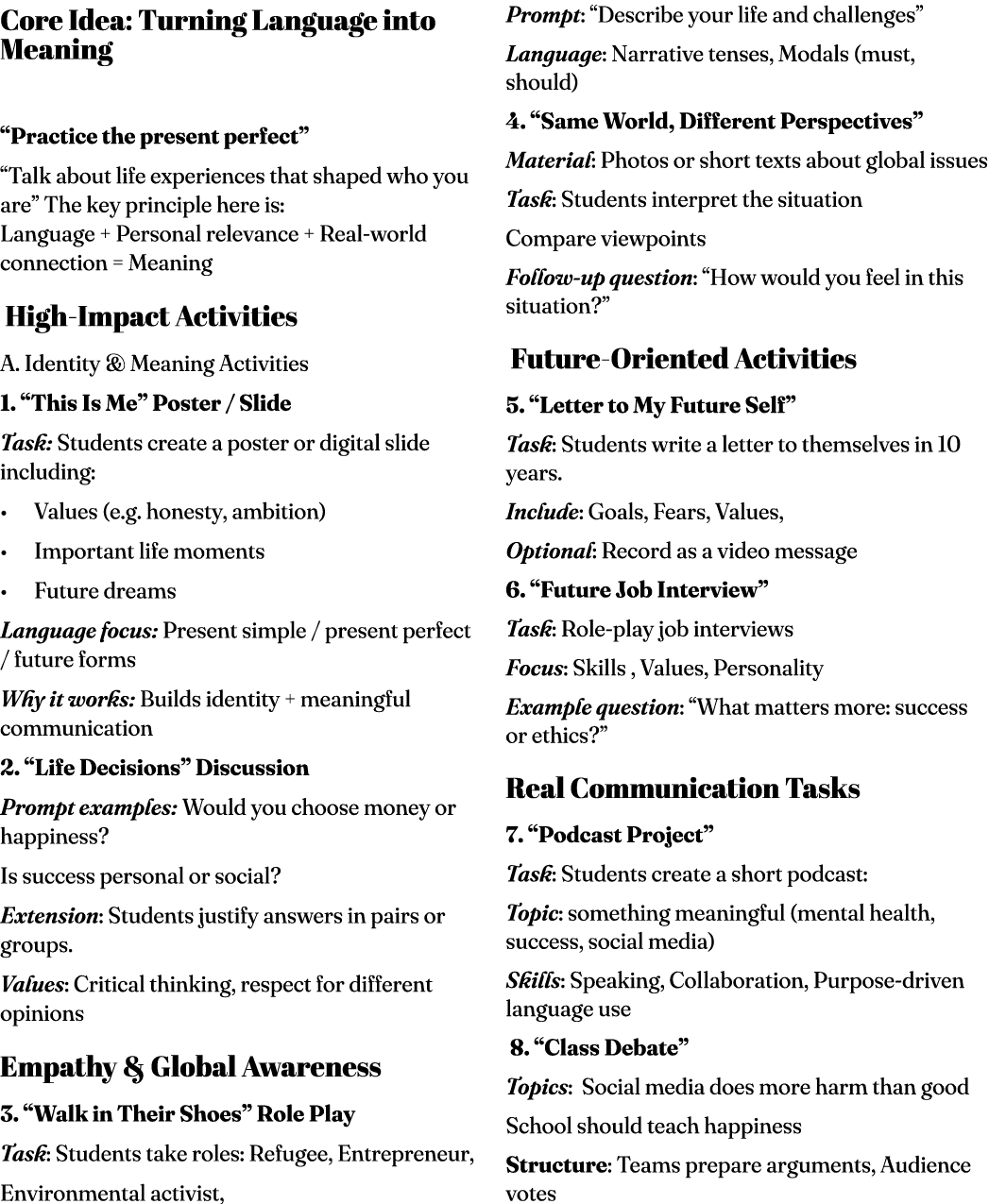
Core Idea: Turning Language into Meaning
“Practice the present perfect”
“Talk about life experiences that shaped who you are” The key principle here is:
Language + Personal relevance + Real-world connection = Meaning
High-Impact Activities
A. Identity & Meaning Activities
1. “This Is Me” Poster / Slide
Task: Students create a poster or digital slide including:
• Values (e.g. honesty, ambition)
• Important life moments
• Future dreams
Language focus: Present simple / present perfect / future forms
Why it works: Builds identity + meaningful communication
2. “Life Decisions” Discussion
Prompt examples: Would you choose money or happiness?
Is success personal or social?
Extension: Students justify answers in pairs or groups.
Values: Critical thinking, respect for different opinions
Empathy & Global Awareness
3. “Walk in Their Shoes” Role Play
Task: Students take roles: Refugee, Entrepreneur,
Environmental activist,
Prompt: “Describe your life and challenges”
Language: Narrative tenses, Modals (must, should)
4. “Same World, Different Perspectives”
Material: Photos or short texts about global issues
Task: Students interpret the situation
Compare viewpoints
Follow-up question: “How would you feel in this situation?”
Future-Oriented Activities
5. “Letter to My Future Self”
Task: Students write a letter to themselves in 10 years.
Include: Goals, Fears, Values,
Optional: Record as a video message
6. “Future Job Interview”
Task: Role-play job interviews
Focus: Skills , Values, Personality
Example question: “What matters more: success or ethics?”
Real Communication Tasks
7. “Podcast Project”
Task: Students create a short podcast:
Topic: something meaningful (mental health, success, social media)
Skills: Speaking, Collaboration, Purpose-driven language use
8. “Class Debate”
Topics: Social media does more harm than good
School should teach happiness
Structure: Teams prepare arguments, Audience votes
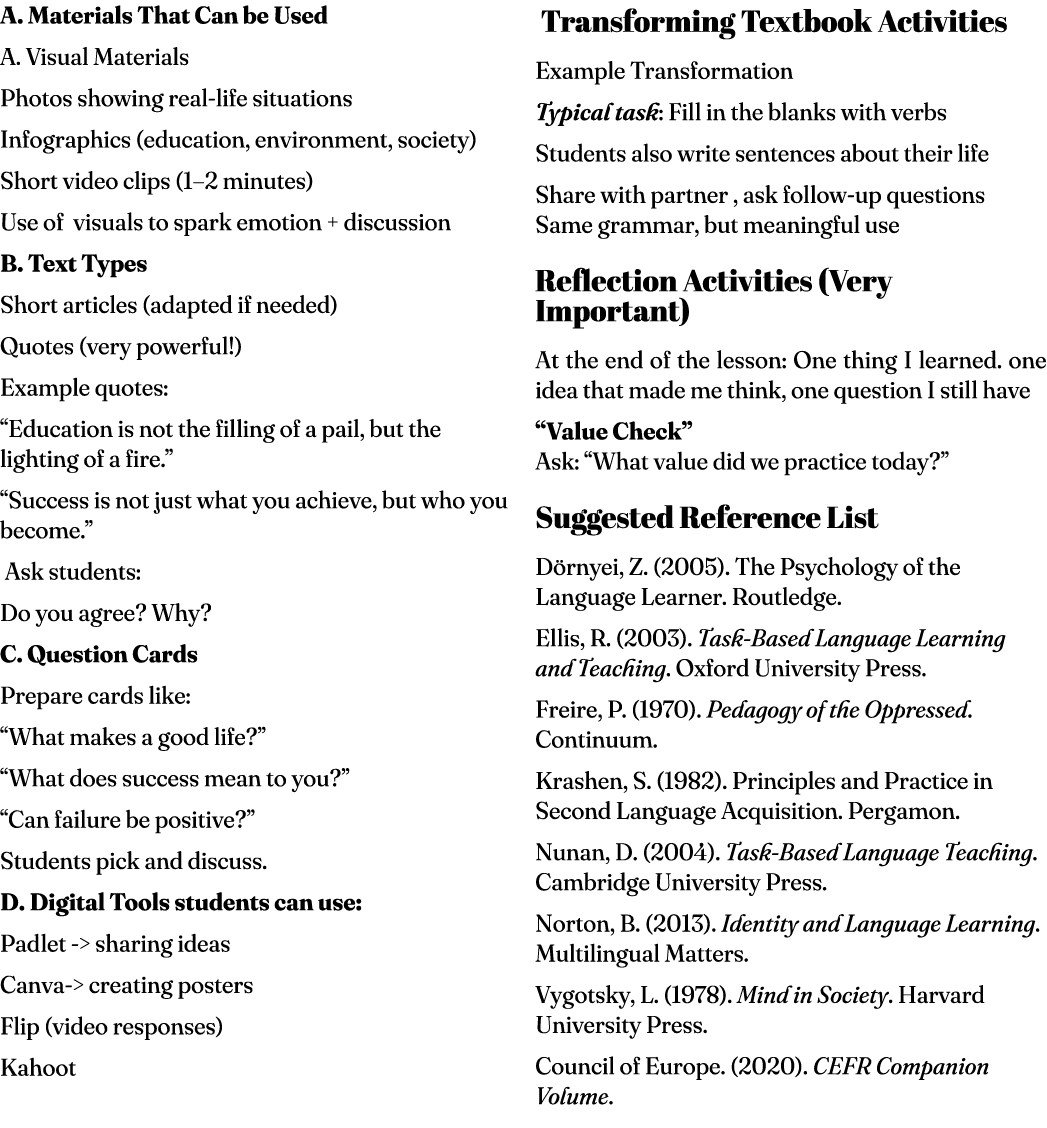
A. Materials That Can be Used
A. Visual Materials
Photos showing real-life situations
Infographics (education, environment, society)
Short video clips (1–2 minutes)
Use of visuals to spark emotion + discussion
B. Text Types
Short articles (adapted if needed)
Quotes (very powerful!)
Example quotes:
“Education is not the filling of a pail, but the lighting of a fire.”
“Success is not just what you achieve, but who you become.”
Ask students:
Do you agree? Why?
C. Question Cards
Prepare cards like:
“What makes a good life?”
“What does success mean to you?”
“Can failure be positive?”
Students pick and discuss.
D. Digital Tools students can use:
Padlet -> sharing ideas
Canva-> creating posters
Flip (video responses)
Kahoot
Transforming Textbook Activities
Example Transformation
Typical task: Fill in the blanks with verbs
Students also write sentences about their life
Share with partner , ask follow-up questions Same grammar, but meaningful use
Reflection Activities (Very Important)
At the end of the lesson: One thing I learned. one idea that made me think, one question I still have
“Value Check”
Ask: “What value did we practice today?”
Suggested Reference List
Dörnyei, Z. (2005). The Psychology of the Language Learner. Routledge.
Ellis, R. (2003). Task-Based Language Learning and Teaching. Oxford University Press.
Freire, P. (1970). Pedagogy of the Oppressed. Continuum.
Krashen, S. (1982). Principles and Practice in Second Language Acquisition. Pergamon.
Nunan, D. (2004). Task-Based Language Teaching. Cambridge University Press.
Norton, B. (2013). Identity and Language Learning. Multilingual Matters.
Vygotsky, L. (1978). Mind in Society. Harvard University Press.
Council of Europe. (2020). CEFR Companion Volume.



![[ ISSUE 5 | JUNE 2026 ]](assets/images/item_279981.png)







![[ editorial ] 4 What Still Matters Most [ edunews ] 9 Cambridge English Digital Young Learner Exams Earn Internationa...](assets/images/item_311777.png)






![[ editorial ]](assets/images/item_296335.png)





![[ edunews ]](assets/images/item_297817.png)




![[ edunews ]](assets/images/item_307421.png)






![[ edunews ]](assets/images/item_301382.png)



![[ edunews ]](assets/images/item_309668.png)







![[ edunews ]](assets/images/item_309858.png)

![[ edunews ]](assets/images/item_309885.png)


![[ edunews ]](assets/images/item_310074.png)




![[ edunews ]](assets/images/item_310097.png)


![[ edunews ]](assets/images/item_310249.png)



![[ edunews ]](assets/images/item_310300.png)





![[ ELT ONLINE]](assets/images/item_308704.png)



![[ Global Voices ]](assets/images/item_290603.png)
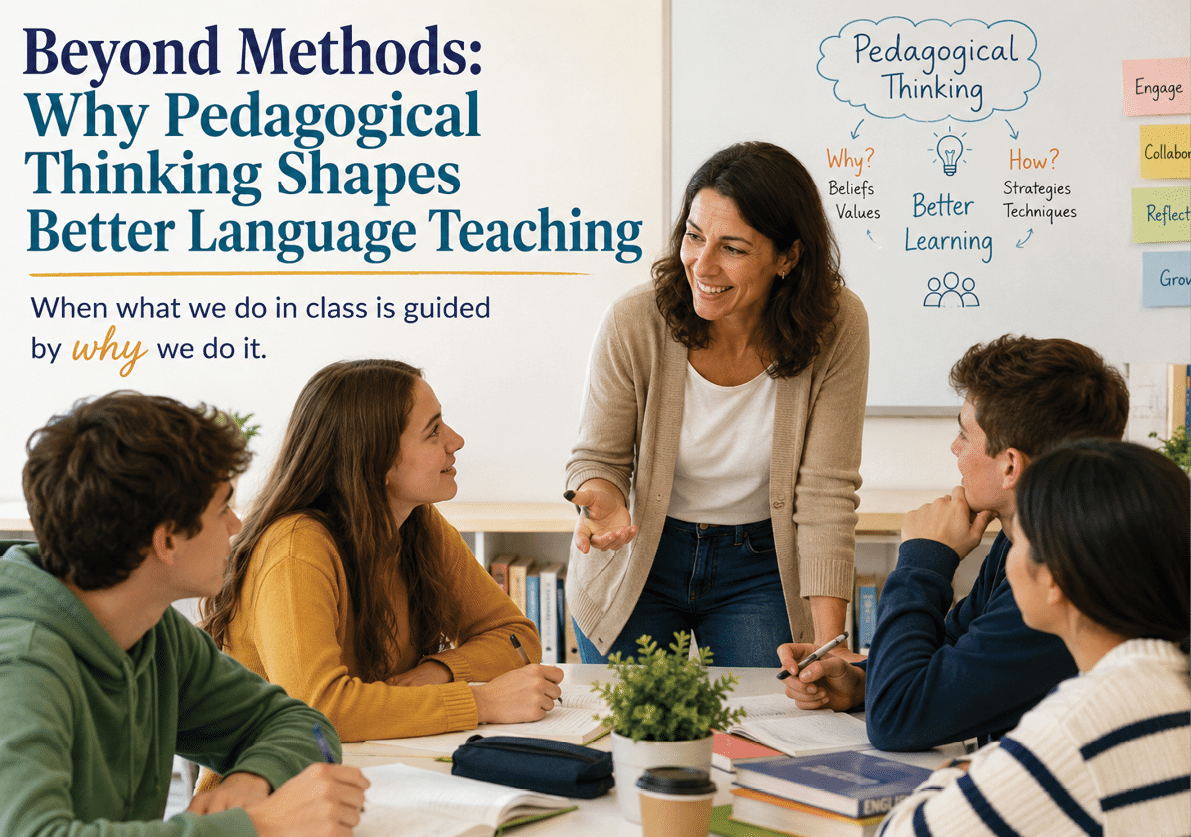






![[ Global Voices Beyond Methods: Why Pedagogical Thinking Shapes Better Language Teaching ]](assets/images/item_302034.png)
![[ Global Voices Beyond Methods: Why Pedagogical Thinking Shapes Better Language Teaching ]](assets/images/item_310642.png)





![[ Global Voices ]](assets/images/item_302285.png)




![[ Global Voices Meaning and Values in English Language Learning ]](assets/images/item_302332.png)


![[ Global Voices Meaning and Values in English Language Learning ]](assets/images/item_306343.png)


![[ Global Voices Meaning and Values in English Language Learning ]](assets/images/item_310963.png)
![[ Interview ]](assets/images/item_304207.png)


![[ Global Voices ]](assets/images/item_311112.png)




![[ Global Voices The Nervous System Curriculum ]](assets/images/item_311139.png)



![[ Global Voices The Nervous System Curriculum ]](assets/images/item_311336.png)
![[ Global Voices ]](assets/images/item_311419.png)







![[ Global Voices The effects of teacher talk on students’ oral production skill ]](assets/images/item_311596.png)



![[ Opinion ]](assets/images/item_304965.png)





![[ Opinion ]](assets/images/item_305081.png)

![[ Opinion ]](assets/images/item_311684.png)