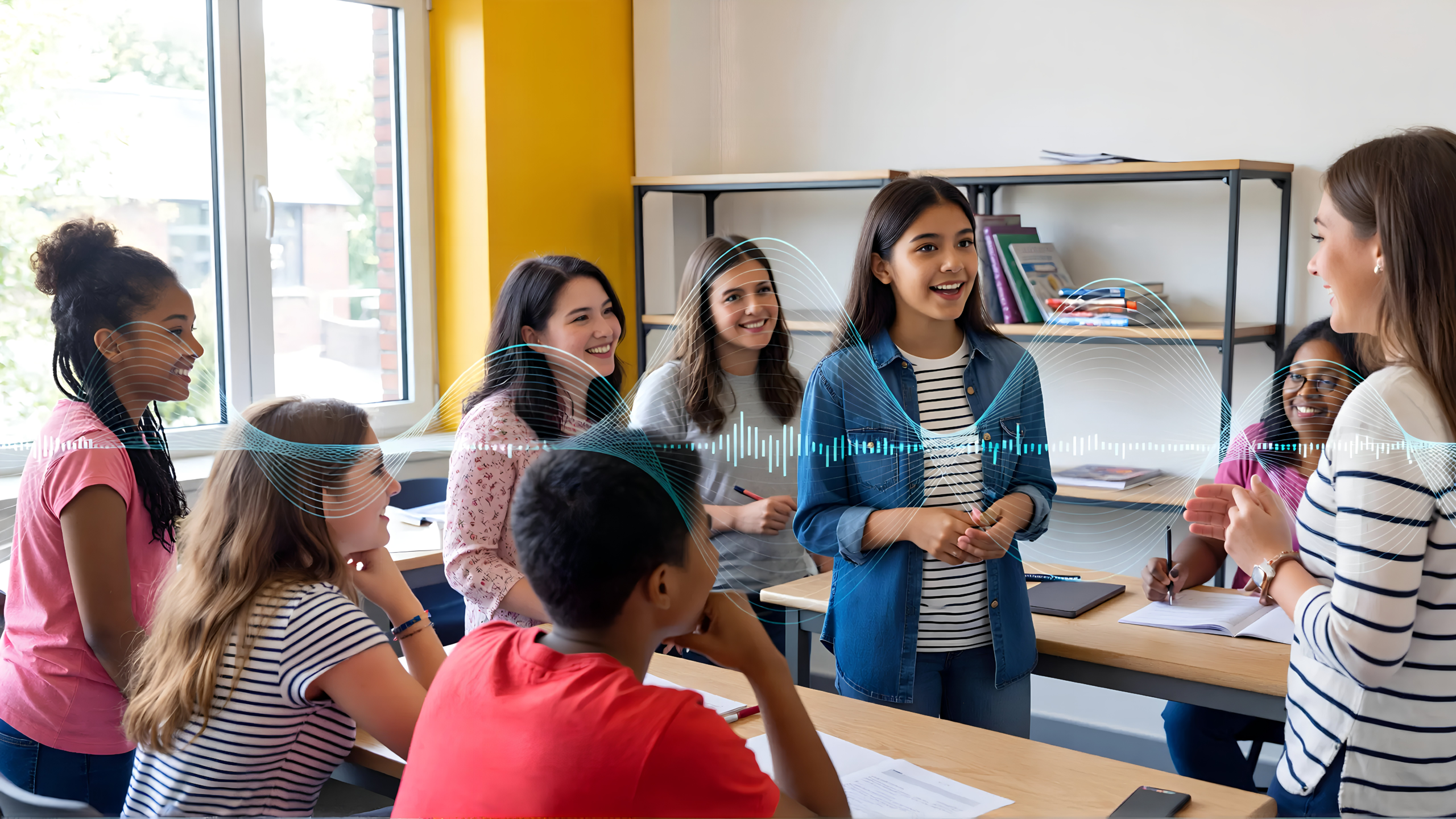
Fluency, learner autonomy, confidence, willingness to communicate, the affective filter, emotional resilience, vocabulary and grammatical range — to name but a few — are some of the challenges a skilled speaker must tackle. Becoming a strong and expressive speaker in a second language isn’t easy. It’s tough, but absolutely worth it.”
Some Teen Candidates: (Probably going through the silent period)
“I feel anxious speaking in front of the whole class.”
“Oral exams overwhelm me.”
“I make mistakes… so I’d rather stay silent.”
Some Teachers:
“Don’t worry,we’ll prepare the answers in advance.”
Examination Day:
Robotic delivery
Memorized responses.
Forced fluency
Lack of Autonomy.
Real communication, Missing!!
Is it a pass?
Of course it is. The candidate has ticked all the boxes.
Can the examiner tell the answers were rehearsed?
Absolutely. Every line sounds memorized.
Could you really believe a 13-year-old spontaneously said,
“Let me collect my thoughts”?
Unlikely. But it fits the script.
Obviously, there are several issues that need to be discussed.
The Exam
Assessment Criteria
Let’s begin with the gap between exam criteria and demonstrating authentic communicative ability. In most exams the set of assessment criteria include pronunciation, range of vocabulary, grammatical control, discourse management and interactive communication. Is meeting the criteria enough, though? “The accurate measurement of oral ability is not easy. It takes considerable time and effort to obtain valid and reliable results” (Hughes, 1992, p114) What about memorized responses, overuse of fillers, unnatural phrasing and limited flexibility when the topic of the conversation changes? What about real communicative competence? Are the candidates able to express original ideas and respond naturally? As Vassilakis points out (2022) “Language learning and language use is now described in terms of increasingly more mundane ‘can-do’ statements and lists of associated grammatical structures and lexical items, which create the illusion that human communication is much simpler than it actually is and that being able to communicate in a foreign language is merely a function of accumulating discrete items so that you can tick off boxes.”
Authentic communicative ability means engaging in real interaction — not just delivering a speech. It involves reacting spontaneously, even emotionally; self-correcting when necessary; asking for clarification; and sharing genuine thoughts and opinions, mistakes and all. The speaker is hesitant, messy and imperfect but real, that’s real language in use. However, when learners and teachers focus on meeting the exam criteria the goal becomes performance rather than communication. When we focus on getting “a pass” students perform well and use all the exam strategies that we teach them without even building their competence to speak freely outside the exam setting. So, they may pass the exam but fail to function in the real world. Ultimately, when the exam becomes the curriculum, we risk sacrificing communicative growth for test performance.
Examination topics
The Spring Oral Examination period for high-stakes exams begins around May 10th and runs until mid-July. This means the same topics are used for nearly two months — making them easy to leak, circulate, photocopy, distribute, memorize, and ultimately, ace the oral exam without genuine communication. Of course, preparing exam material is tricky — but let’s be honest, that’s exactly why we call them high-stakes exams. They’re supposed to ensure content validity, face validity, criterion-related reliability… and all that. Can’t there be a way to renew or rotate oral exam topics to prevent leakage and protect reliability? After all, if topics are reused over two months, how can we ensure fairness, authenticity, and equal challenge for all candidates?
The Teacher
The EFL teacher in Greece carries a heavy burden. Too often, our worth is judged solely by exam results. That’s not just unfair — it’s untrue.
Are we expected to prepare students for exams?
Definitely.
Are we victims of the system?
Yes — but we’re also, to some extent, accountable.
It’s time to push back.
It’s time to find the strength to persuade parents and stakeholders that the ultimate goal isn’t just to pass a test — it’s to teach, and for the student to learn.
Many teachers across Greece are already leading the way, embracing task-based learning, project work, and digital tools to foster real communication and critical thinking — not just memorisation.
The Student
The rise of social media, YouTube, and podcasts has made it easier than ever for teens to develop listening and speaking skills. In many cases, students perform well in these areas. However, there are still some who are reluctant in the classroom — and they often have a variety of explanations for being unwilling to speak.
The fear of making mistakes is one of the main reasons students choose to stay silent — and we can’t really blame them. After all, who wants to risk embarrassment in front of their peers? We all know how harsh and judgmental children can be. For some students, silence feels safer than the risk of being ridiculed. “People avoid communication because they believe they will lose more by talking than by remaining silent” (Phillips 1984, cited in Keaten et al.2000)
The classroom environment can sometimes feel hostile, especially for learners with low self-esteem. According to Krashen (1982), “error correction has the immediate effect of putting the student on the defensive.” When students feel exposed or judged, their willingness to speak decreases. Krashen (1982) also argued that error correction is not the primary mechanism for improving second language performance. Instead, a more supportive, low-anxiety environment is essential for meaningful language acquisition. While the EFL classroom may have inadvertently contributed to learners’ disfluency (Peltonen, 2024), this can be addressed by promoting spontaneity and reducing pressure. A more supportive, low-anxiety environment is essential for meaningful language acquisition. A stress-free classroom climate can help silent learners become confident communicators. Instead of correcting every mistake, focus on the message. Save grammar correction for later, reinforce the idea that mistakes are part of the learning process, and handle them with humour and grace. Too often, we ask students to rehearse and memorize — but real communication happens in real time. Instead, we should encourage spontaneous language use by integrating speaking games or image-based tasks that cannot be prepared in advance. Foster personal expression by asking open-ended questions, promoting group work, and helping students connect emotionally to a topic. Give them opportunities to express their preferences, opinions, and experiences. Simulate real-world situations that require them to think on their feet — this is where genuine fluency begins to develop.
Let’s retrace our steps. Let’s rediscover the true meaning of teaching:
Not to train test-takers, but to build thinkers, communicators, and lifelong learners.
References
Keaten, J. A., & Kelly, L. (2000). Reticence: An affirmation and revision. Communication Education, 49(2), 165–177.
Krashen, S. D. (1982). Principles and practice in second language acquisition. Pergamon Press.
Meihua Liu. (2009). Reticence and anxiety in oral English lessons. Peter Lang.
Peltonen, P. (2024). Key concepts in ELT: Fluency revisited. ELT Journal, 78(4), 489–491. https://doi.org/10.1093/elt/ccad047
Phillips, G. M. (1984). Reticence: A perspective on social withdrawal. Communication Quarterly, 32(3), 219–229.
Vassilakis, G. (2022, February 8). Confessions of a dangerous (ELT) mind. ELT News. https://eltnews.gr/post/george-vassilakis-confessions-of-a-dangerous-elt-mind