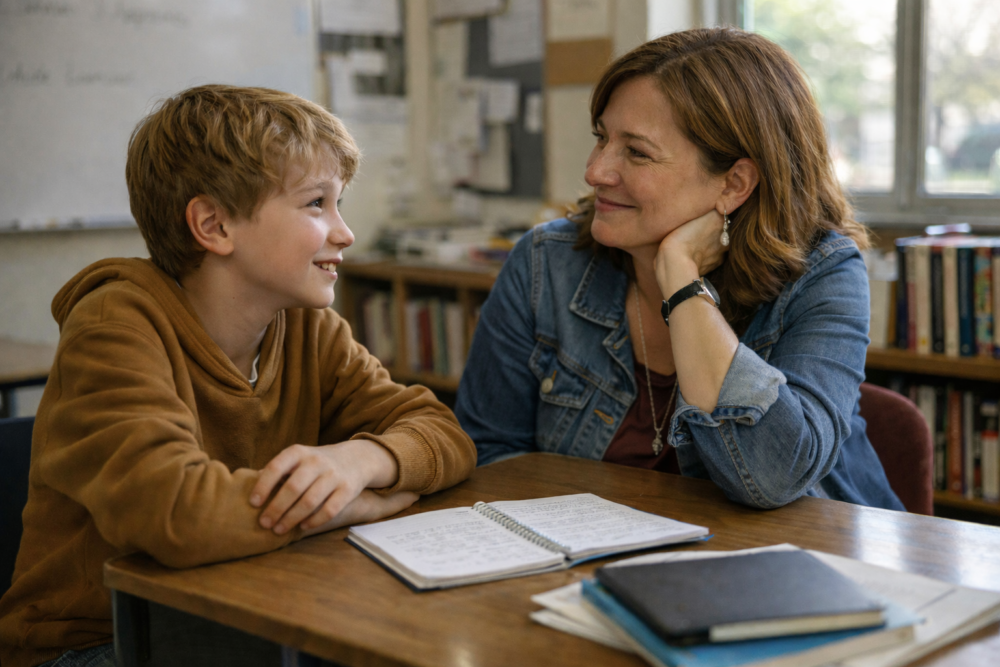
After a discussion I once had with one of my classes, I realized that they had had the impression that ‘teachers’ are not human beings like them but something like programmed entities –as if we were operating on software programmed solely to teach, assess, and impose fines on inadequate performance and unacceptable behaviour. I was astonished by my students’ perception of their teachers. At that very moment, it became clear to me that there is a profound gap between the way I view myself as a teacher and the perception my students hold. In other words, I came face to face with the need to prove to them, through my everyday lessons, that we teachers are not made up of ‘sensors’—like robots—but of ‘senses’! Sensors can tell when they are noisy, but senses can tell the reason why—be it anxiety, worry, stress, or even just boredom!
The truth is, it is easy to understand how this disconnect occurs. Sometimes we forget that we are human beings teaching fellow humans—which means that we often feel the need to suppress our emotions to stay ‘professional’. Time constraints, syllabus completion, or even classroom management leave us no time to realize that this behaviour on our part seems almost robotic -a fact that reinforces our students’ perception of us as programmed entities.
However, a soulful connection is vital in every human relationship. Bearing this in mind, spending moments in our lessons to reveal our inner selves and express our feelings is never a waste of time. On the contrary, it is a valuable investment that sets the foundation for a genuine, solid relationship with our students.
The steppingstones that lead us to this worthy, powerful, soulful connection with our students include:
- Expressing enthusiasm for one of their achievements, no matter how minor it may be.
- Showing genuine concern about their performance due to inadequate preparation.
- Sharing our anxiety about the final outcome of a project they have been assigned.
- Admitting our sadness about a student’s lack of self-belief.
- Feeling frustration and distress when their behaviour fails to respect the rules.
- Expressing our heavy-heartedness when we are obliged to enforce discipline and apply consequences for misbehaviour.
These moments of emotional expression help our students feel that we are human beings just like them. And then, something magical happens! They can feel our emotional vibes—sensing our authenticity as human entities. This places us close to them and gives trust to the necessary room to grow and blossom. Trust, after all, is the cornerstone of a safe and thriving learning environment.
When trust is established, students stop following the rules merely out of fear of a penalty they wish to avoid. They realize that if they give up or disrupt the class, they aren’t just ‘breaking a rule’ but a ‘moral contract’— letting down a human being who has shown them enthusiasm, distress, genuine concern. Our shared ‘senses’ set the ground for trustworthy accountability. They aren’t afraid to make mistakes; they experiment, they make attempts, they never give up, and—most of the time—they do their bestfor the sake of trust they are unwilling to betray. Our shared ‘humanity’ effortlessly brings mutual respect into our classroom management—respect that our students honour and eagerly desire to see continued.
In this way, a resilient learning community is created. Even when the grammar is challenging and the vocabulary is complex, our students persevere because the ‘soulful connection’ we have built provides a safety net that no ‘robotic’ system could ever offer. Errors are no longer viewed as evidence of incompetence, but as courageous attempts to move forward and as necessary milestones of improvement. Our students learn to accept them as a vital route to successful language acquisition. They are convinced that ‘mastering’ the foreign language— ‘conquering’ new grammar structures and vocabulary—is inevitably achieved through trial and error.
At the same time, on the other side of the scale, teachers themselves also benefit from this honest emotional externalisation. By devoting some time to express our feelings and, thus, allow ourselves to be seen—to be delighted, to be heavy-hearted, to be authentically human, we actually invest in a shared journey with our students. Even though it may initially seem like a waste of time, causing the curriculum to fall behind, in the long run, it proves to be the most valuable investment. We become their partners in a soulful workshop, where our vulnerability ceases to be a weakness. Instead, it becomes our most powerful pedagogical tool. It is what allows us to stay close to them as they struggle with the difficulties of the language. In a shared space, where students have been allowed to meet us halfway, time is saved from inappropriate behaviour, loss of attention, anxiety, and stress that hinder improvement.
So, let’s take a break and wonder: Is it just sole teaching, or also soul teaching?