Few things are more powerful in education than offering students the chance to learn through doing, especially when that “doing” connects them to their local environment and cultural identity. On the small island of Kea, a pilot programme called Experiential Projects set out to explore exactly that. Over the course of three months, a group of teenage EFL students stepped outside their classroom and into their island’s maritime history, learning English not from textbooks, but through discovery, creation, and community engagement.
The programme was developed in response to a growing challenge faced by many EFL educators: a lack of motivation among students who are often immersed in exam-oriented teaching. In many classes, language learning becomes detached from personal meaning, and students struggle to see how English relates to their real lives. Experiential Projects was therefore designed and implemented at the Language Centre I own on Kea island, with the aim of turning English lessons into relevant, engaging, and authentic experiences. To achieve this, the project centred around a unique local asset: the Kea Underwater Historic Site (KUHS), a unique marine area of international importance located around the island.
Officially designated in 2019, KUHS became the first underwater historic park in Greece. Created to protect the island’s maritime heritage, it includes four significant wrecks: the HMHS Britannic (sister ship of RMS Titanic), the SS Burdigala, the Patris (the first steamboat of Greece) and a German WWII aircraft (Junkers 52). The site is now a legally protected marine zone that prohibits fishing and aims to regenerate marine life while safeguarding these submerged monuments.
Through research, interviews, and educational visits, students were able to investigate these sites in depth. A key part of this process was the collaboration with Kea Divers, a professional diving centre with decades of experience. Its founder, Mr. Yiannis Tzavelakos, provided both technical knowledge and personal insights. He welcomed students into the dive centre, shared stories from his work with National Geographic, DW and the Greek Ministry of Culture and highlighted the importance of preserving underwater heritage.
“Learning is the process whereby knowledge is created through the transformation of experience .”
– David Kolb (1984)
Piloted with a group of B2-level students, the programme was structured around Kolb’s experiential learning cycle: concrete experience, reflective observation, abstract conceptualization, and active experimentation. The intention was to link language acquisition with something deeply rooted in the learners’ surroundings, the island’s own cultural heritage. To support this process, a dedicated blog (https://experientialprojects.blogspot.com/ ) was designed specifically for the programme. Every key moment, from research stages to collaborative meetings, was posted online, keeping the local community informed and engaged. Beyond its communicative function, the blog also served as a kind of digital journal, capturing the learning journey and providing a space for reflection and documentation.
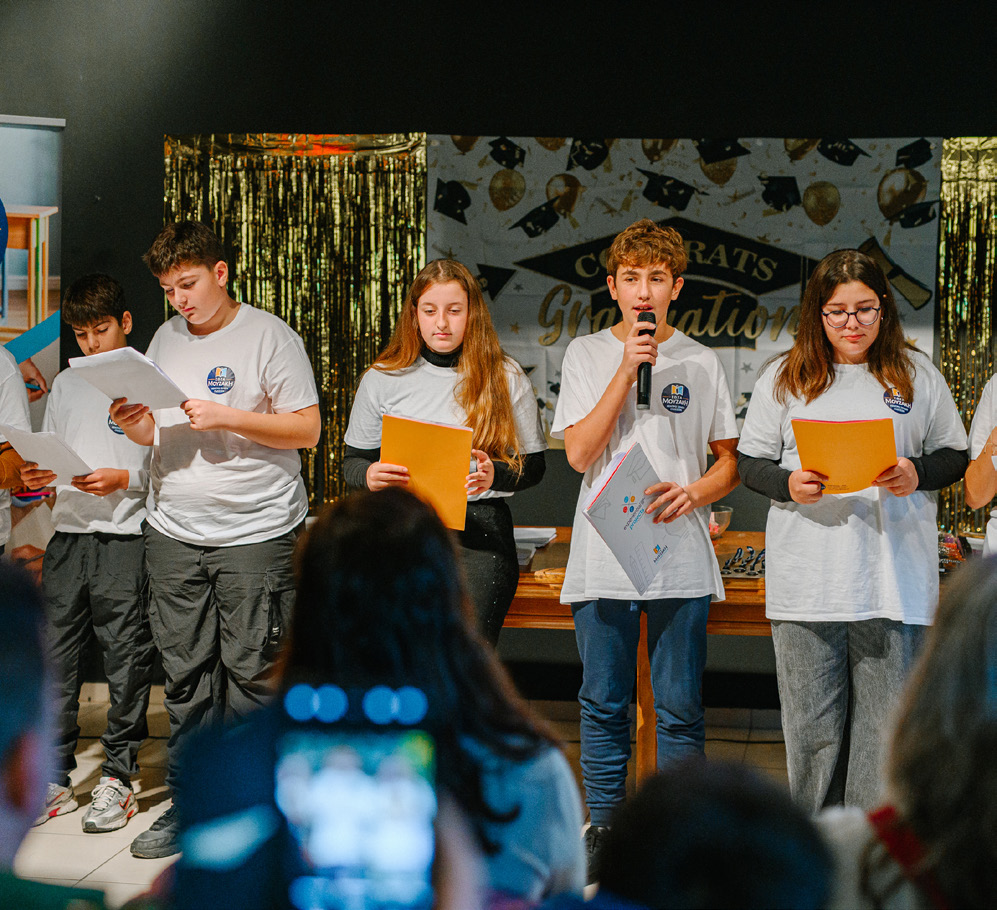
Sessions took place every Saturday, outside regular class hours, highlighting the programme’s voluntary nature and the students’ personal engagement. Week after week, learners came together to research, plan, discuss, and co-create. The project culminated in a public presentation, where students showcased their work in English. It was an opportunity not only to practice language skills in an authentic context, but also to share the story of their island. Parents, local residents, and guests attended the event, offering enthusiastic feedback and expressing appreciation for the students’ efforts and the cultural value of the project.
Apart from a dynamic learning experience for students, the programme also served as a case study for my postgraduate dissertation, exploring how heritage and experiential learning can be integrated in English language teaching. The study was built around three research questions. The first examined how heritage-based experiential learning can be implemented in EFL classrooms in small communities. The findings indicated that such programmes, when grounded in local identity and supported by structures like Kolb’s experiential cycle, are both feasible and impactful, even within limited-resource settings.
The second research question focused on the effects of the programme on students’ language skills, motivation, and cultural awareness. Students demonstrated clear progress in spoken and written English, especially in tasks connected to their research and final presentation. More importantly, they showed renewed interest in learning, stronger personal engagement, and a deeper sense of pride in their local heritage. The experience reshaped their perception of English, not merely as a school subject, but as a means of exploring, expressing, and participating in the world around them.
The third research question addressed whether the project could serve as a replicable model. The evidence gathered confirmed its potential to be adapted to other similar communities. Its structure, explore, experience, create, share, proved flexible enough to fit different local contexts, provided there is teacher engagement and connection to relevant cultural content. Also, the programme highlighted that educational innovation doesn’t depend on advanced infrastructure, but on purposeful design, student-centred practice, and meaningful ties with the surrounding community.
In 2025, Experiential Projects received the Silver Award at the ELT Excellence Awards in the category Excellence in Teaching Foreign Languages. Following its successful implementation and impact, the programme will now be run annually at our language centre on Kea Island. Plans are also underway to make it available for adoption by other foreign language centres, through guided collaboration and pedagogical support.
To conclude, every place has its own story. Even small communities hold a wealth of cultural heritage that can inspire meaningful and experiential educational content. When local history is brought into the EFL classroom, the learning process transforms from something mechanical into something living, creative, and full of purpose. Students do not simply learn the language. They live it!