An allegorical story as it is told by Zafi Mandali
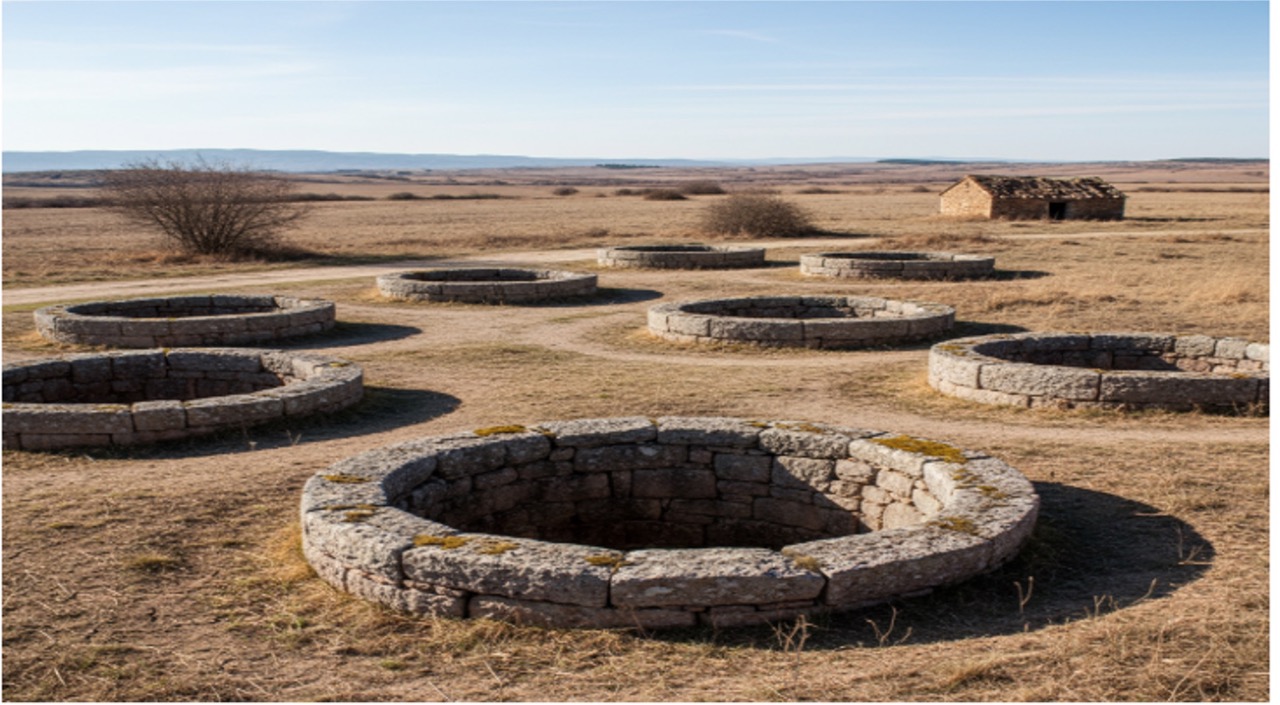
The city in our story was not inhabited by people like all the other cities on the planet. In this city lived wells. Just wells; nothing else.
The wells differed from one another. They had been dug in various places, and they connected to the outside world through their openings. Some wells were wealthy and luxurious. Their rims were made of marble and beautiful metals. Others were humble, made of brick and wood. Still others were poor; they were simple, bare holes opened in the earth. Any communication happening between these wells took place from rim to rim to rim. News traveled quickly from one end to the other.
One day, a fashion, from a human village, reached the city. The new idea was that every living being that respected itself should care far more about its interior than its exterior. What mattered was not the surface, but the content.
And so it happened: the wells began to fill themselves with objects. Some filled themselves with precious stones. More practical ones filled themselves with electrical appliances and machines. Others chose art and filled themselves with paintings, grand pianos, and sculptures. Finally, the intellectual wells filled themselves with books, ideological manifestos, and specialized journals. Time passed. Most of the wells filled up to such an extent that nothing more could fit inside them.
The wells had to decide what to keep doing. Some decided to stop accumulating more things. Others tried to find ways to make space to accumulate more things inside them. One of them took an initiative. It decided to increase its capacity by widening its space. Soon other wells began to imitate the new idea and spent a large part of their energy expanding and gaining more space within themselves.
Two wells began to worry seeing that their companions expanded without measure. It was obvious that if they continued widening in this way, they would soon blur their boundaries, and each one would lose their identity. These two wells, which had never met, had the same idea. They thought that a different way to increase their capacity would be to grow not by widening, but by deepening. They decided to expand in depth rather than in width.
These two wells, which were far from each other and had no communication with each other, soon realized that the deepening was impossible with all the things inside their wells. If they wanted to become deeper, they would have to get rid of all their contents.
At first, the emptiness frightened them, but later, seeing no other choice, they started getting rid of their contents. The other wells grabbed the objects they threw away but they felt that with nothing in their possession, they started deepening.
One day, the wells that were growing downward and had become very deep got a surprise. They found water!! No other well around them had found water. The wells, overjoyed and astonished, began to play with the water, soaking their walls, splashing their rims, and finally bringing the water up to the surface. The city had never been wet from anything other than rain, which was quite rare. So, the earth around these two wells was nourished and began to awaken. Seeds sprouted, taking the form of grass, clover, flowers, and fragile stems that later turned into trees. An explosion of color and life spread around the remote wells, which people began to call “the garden.” Everyone asked how these two wells had managed such a miracle.
“It’s no miracle,” the garden would reply. “You have to dig inward.”
Many wanted to follow the garden’s example, but they rejected the idea of emptying themselves first, so as to deepen. Instead, some continued widening so they could fill themselves with even more things.
So, two different oases were created at the end of the city from the water that the wells brought up to the surface. The wells were asked. “What will you do when the water runs out?”
Each replied. “I don’t know what will happen, but for now, the more water I draw, the more water I find.”
A few months passed before the great discovery. One day, almost by accident, the two wells realized that the water they had found in their depths was the same—that the same underground river that flowed through one filled the depths of the other. They understood that a new life was beginning for them. Not only could they communicate from rim to rim on the surface like all the others, but they had discovered a new, secret meeting point.
They had discovered that deep communication is achieved only by those who have the courage to empty themselves of content and search within the depths of their being to find what they have to give.
Comprehension questions & follow up discussion:
The aim is for students to reuse vocabulary multiple times, to practice abstract meaning in a structured way, to boost speaking and to connect language to real life in a scaffolded way.
- What do you think the town of wells represent?
Wells represent human society. This story chooses wells and water instead of people and emotions. This story represents a contrast between living superficially and living a profound life. Each well symbolizes a person. The exterior of the wells—their marble rims, bricks, or simple openings—represent outward appearance, social status, and material wealth. The way the wells initially fill themselves with valuable stones, art, and books reflects how people often define themselves. People define themselves based on their possessions, achievements, knowledge, or ideology. They focus on accumulation rather than inner growth.
- Some wells began widening instead of deepening while others began digging deeper. What symbolism do you find here?
The suggestion is that societies are obsessed with expansion, comparison, and external success, even at the cost of losing individuality. In contrast, the wells that choose to empty themselves and dig deeper represent self-reflection, humility, and inner work. When the two wells let go of what they had accumulated, they discover water which in the story symbolizes inner truth, wisdom, love, or spiritual depth.
- What does the underground river symbolize?
The underground river which connects the two deep wells represents the shared human essence. It suggests that when people look deeply within themselves, they discover something universal that connects them to others.
- What does the water symbolize?
It symbolizes love, wisdom, confidence, friendship because it is shared and brings good. Water represents confidence because when you deepen your identity, you feel stronger and you can connect better with others.
- Why do you think the wells began spilling the water out?
What they discovered was meant to flow not to be stored. Unlike the objects they had previously collected, water was meant to be shared. The story says that the more water these two wells draw, the more they find. So once the wells connect to this deeper source, giving becomes natural not forced. Spilling the water outward shows a shift in purpose. Before, the wells existed to accumulate. After deepening, they exist to nourish. The water brings life to the land around them, creating grass, flowers, and trees. This suggests that when someone discovers inner depth, it doesn’t just transform them—it benefits the whole community.
- According to the story what does sharing bring?
Sharing the water reflects abundance instead of scarcity. When we live superficially, we fear running out—of status, possessions, recognition. But when we connect to something deeper, we realize the source is renewable. The wells give because they understand the river beneath them is not limited and that it connects them to one another.
- How does the story question identity comes from accumulating?
The accumulation of things by the wells mirrors the pressure the teens often feel to look better, own more, know more, be more impressive as part of their identity. Teenagers are in the middle of figuring out who they are and, in their effort, to achieve more, resemble the wells which widen themselves to hold more things.
- How does the story speak of social pressure?
The “fashion” that spreads through the town reflects trends, peer influence, and comparison. It represents the pressure teens feel from peers and social media. But the story doesn’t attack the pressure. It simply shows the consequences of different choices.
- How does the story introduce emotional courage?
When the two wells empty themselves, they are uncomfortable. The feel fear of being “empty,” of not fitting in, of letting go of what defines them. They find that emptying is necessary. This is emotional courage. Also, this relates to teenagers who often struggle with feeling alone. This story suggests that real connection happens when people are brave enough to look inward.
- Literal versus symbolic vocabulary activity.
| The words go in 2 columns: One column is the literal, and the other is the symbolic meaning. |
| Literal meaning | Symbolic meaning |
| Water: liquid in a well | Wisdom, love, inner ruth |
| Rim: the upper edge of an object | The exterior, appearances, what we show |
| Expand: make something wider | Grow socially or materially |
| Deepen: make deeper | Grow inward, strengthen |
| Widen: become wider | Broaden one’s perspective |
‘
- For me, this story symbolizes the chain that connects people through the wisdom of my fairy tales.