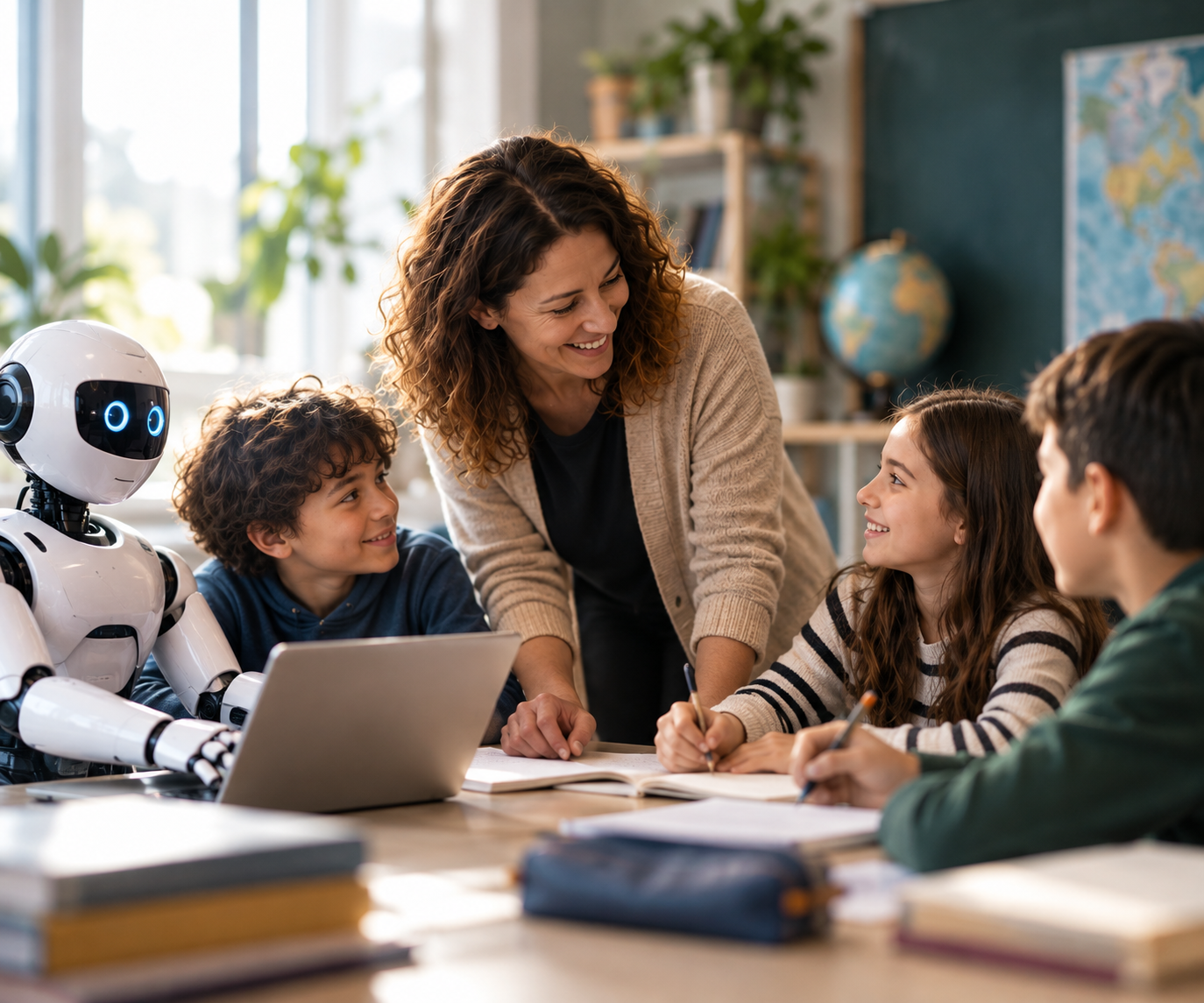
Human history is marked with transitions. There are numerous examples, such as the discovery of fire, the invention of the Wheel, and, much later, the Industrial Revolution. New inventions rarely arrive without fears and questions. AI is here to stay! The best way to confront it may be acceptance.However, let’s first assess it carefully! What can Artificial Intelligence offer to teaching? What do teachers themselves contribute to the learning process? Is there a possible combination?
This article approaches this important issue by presenting key elements and exploring possible forms of co-existence between Artificial Intelligence and human teaching.
The Teacher as Interpreter of Learning
During their classroom work, teachers function in two modes. One of their key roles is to present teaching material. This presentation can take many forms. Technology certainly has a role to play; adapting to innovative methods can support learning and attract learners’ attention. Yet presentation is only one part of the process; the rest remains in the teachers’ hands. But what does this ‘rest” involve?
There are numerous other practical actions into play. Teachers need to analyse learners’ difficulties beyond surface-level mistakes. Often, they need to revisit previously taught material and provide further explanation. They can diagnose deeper problems, such as fossilised errors, and recognise whether the problems may be linked to learning difficulties. At times, they may also need to inform parents. Most importantly, they make decisions about when, how, and why to intervene.
The Teacher as Learning Designer
After recognising the various difficulties students may face in class, the teacher takes on a different role. That is one way to organize the new material: support learners with learning difficulties by selecting and, if needed, adapting it to their needs.
Here lies a crucial difference. AI may produce various kinds of material, but it is the educator who designs and leads the learning journey. Even when a virtual educator is used as a presentation, it is the classroom teacher who has selected, edited, and refined the content.
The Teacher as Emotional Anchor
Nowadays, it seems like the teaching role is in question. In the past, educators held an authoritative lead. Over time, this role has undergone scrutiny, and we have reached a new point where teachers face doubt in classrooms and in society in general. However, the teacher, compared to a machine, surpasses expectations in many ways. Let’s study the reasons.
Teachers build and consolidate knowledge through years of experience. In classrooms, they interact daily with younger generations and receive energy, sourced from their youth. They develop a strong instinct for recognizing the sources of mistakes and continually seek new ways to present material and promote consolidation.
Educators, in real classrooms, act as Emotional Anchors. They develop a kind of selective empathy towards their students. They can feel their learners’ fear of the unknown. Although they tend to “push” for no-mistake tests, they can easily recognize their stressful procedure for not producing any.
Learners need support, encouragement, motivation, and often a role model. This role is fulfilled by teachers in the classrooms. Instead of questioning whether Artificial Intelligence will replace teachers, it may be more productive to strengthen the teacher-learner bond. A friendly classroom rapport and respect from both participants may narrow the borders and foster communication and interaction.
What AI Can Do Well
Now, let’s consider what AI can do well or very well, or even extremely well. One clear advantage is that material production velocity has rocketed. Once educators conclude what they need, they can provide clear instructions and receive results within seconds. However, the keyword lies in the word “instructions”. AI receives instructions to function. And, there are numerous moments when the unclear instructions lead to unsatisfactory results.
AI can also support teachers by providing feedback and corrections. Again, clarity of instructions leads to effective results. Clear and well-structured guidance brings up constructive material. Many are the cases when the teacher has to intervene, refine, correct, and re-create. Nevertheless, Artificial Intelligence becomes a valuable assistant when it comes to correcting written work quickly and efficiently, saving considerable time.
At the same time, AI can provide instant explanations or generate examples. It can also personalise the exercises, adapt them to an appropriate level, and create extra reinforcing material for further practice.
These capabilities may create the impression that the teacher’s role could diminish in the future. Yet from the description above, it becomes obvious that the role of the teacher is prominent even in the simplest language material production.
There are more limitations than one can think of. AI cannot fully understand learners’ deeper needs. First and foremost, it lacks the ability to recognise the learner’s emotional state. It cannot relieve the anxiety, and it cannot create motives for further and extensive studying. Also, it lacks real classroom awareness and cannot perceive that social dynamics are not in its potential. Human interaction is irreplaceable because emotions intervene- something a machine cannot replicate.
Conclusion
All in all, the role of the teacher is not disappearing; it is evolving. The main idea should be to view AI as a tool and not as a competitor. The human educator remains the central figure who instructs, provides direction, and exercises judgment, empathy, and educational vision.
AI can certainly support teachers to save time and expand practice opportunities. However, classrooms still need that standing figure in the middle – the teacher- who helps form the future generations.