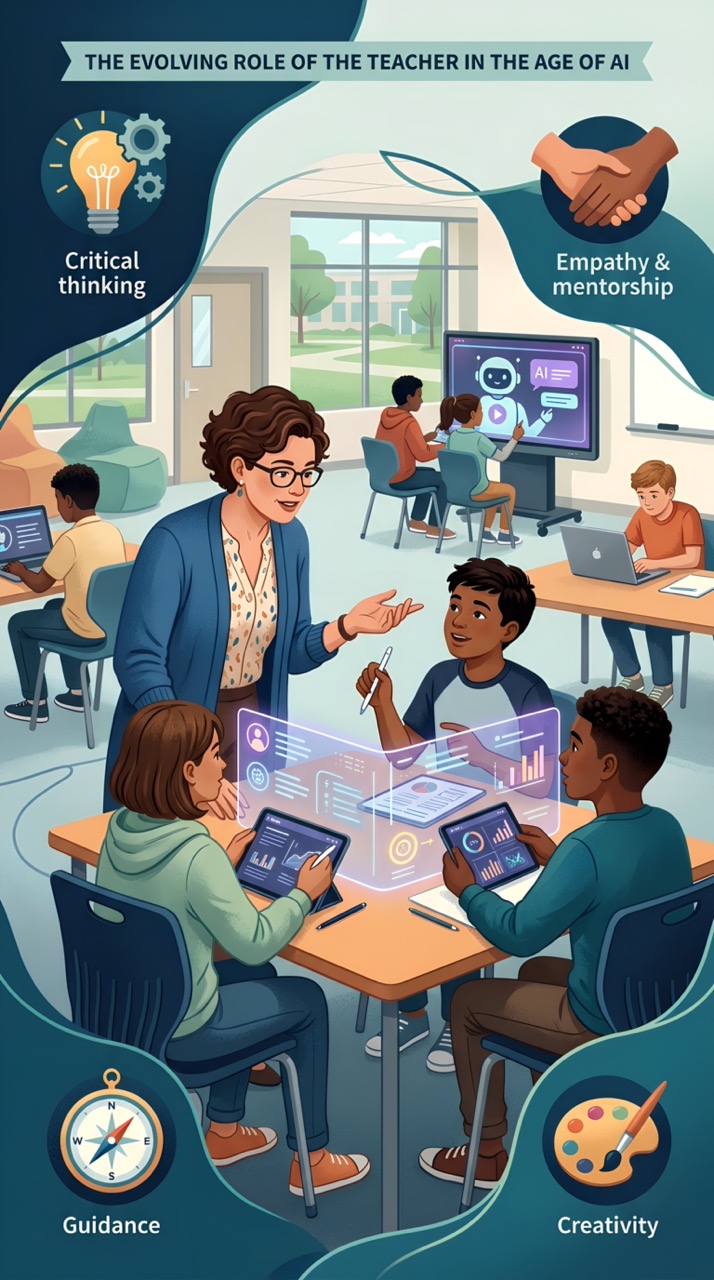
Artificial intelligence can now generate exercises, explain grammar, adapt texts, summarise texts, and provide rapid feedback on writing. These changes are already affecting classroom practice. Major organisations such as UNESCO, OECD, and the British Council do not treat AI as a passing trend. At the same time, they are equally clear that AI in education requires human oversight, ethical safeguards, and strong professional judgment (British Council, n.d.; OECD, 2026; UNESCO, 2023).
So where does that leave the teacher?
Not replaced. Repositioned and, in some respects, made even more important.
AI can speed up parts of teaching, but it cannot replace pedagogy. A teacher can now draft differentiated activities faster, prepare examples more efficiently, and reduce some low-value administrative workload. That matters, especially in language education, where planning, feedback, and adaptation take significant time. But speed is not the same as educational value. A worksheet produced in seconds is not automatically suitable for a specific learner, class, age group, or objective. AI does not know the student in front of us unless the teacher brings that knowledge into the process.
This is why the discussion now has to become more specific. In the age of AI, teachers need more than access to tools. They need AI literacy. UNESCO’s AI Competency Framework for Teachers sets this out clearly by identifying five dimensions of competence: a human-centred mindset, ethics of AI, AI foundations and applications, AI pedagogy, and AI for professional learning (UNESCO, 2026). That is an important shift. It tells us that AI should not be treated as a novelty skill or an optional extra. Teachers need structured preparation to understand what these systems can do, where they fail, and how to use them responsibly.
One area where this is especially urgent is safety. The British Council’s guidance for teachers is practical and direct: use school-approved tools with clear privacy protections, avoid uploading learner-identifiable data to public systems, upload only parts of student work when necessary, and manually review AI-generated marks or comments before giving them to learners (British Council, n.d.). These are not minor technical details. They are part of a teacher’s professional duty of care. In schools and language centres, student data cannot be treated casually simply because a tool is convenient.
Teachers also need to be trained to detect hallucinations. One of the risks of general-purpose AI is that it can produce false information, weak reasoning, or inaccurate feedback in highly fluent language. That makes error detection harder, not easier.
A confident explanation is not always a correct one. This means teachers need the habit of checking outputs, verifying claims, and spotting when AI-generated material sounds polished but is educationally weak. UNESCO’s guidance on generative AI stresses human capacity development for exactly this reason: these technologies require users who can question them, not just operate them (UNESCO, 2023).
A further point, in my view, is still underestimated. Not all AI tools are equally suitable for education. OECD’s latest work argues that general-purpose generative AI tools are not designed to help students learn; they are largely built to do tasks for users. By contrast, tools designed specifically for educational purposes can be aligned more closely with pedagogy, learner progression, feedback structure, and teacher oversight (OECD, 2026). That distinction matters. The most popular tool is not automatically the most educationally appropriate tool.
This is also where I would add a personal note.
As someone working closely with educational AI, I do not see the real opportunity as replacing teachers or automating classrooms into something impersonal. I see the opportunity in helping teachers move beyond one-size-fits-all teaching. When specialised educational AI is used properly, it can help a teacher identify learner gaps faster, notice patterns across student performance, and provide more personalised support than a purely whole-class model often allows. In language education, that can mean responding more effectively to different readiness levels, different rates of progress, and different support needs. The goal is not to remove the teacher from the centre. The goal is to give the teacher better tools to support each learner more precisely.
This ultimately strengthens, rather than weakens, the role of the teacher. In language education especially, teaching is not just content delivery. It is diagnosis, timing, encouragement, judgment, and relationship. It is knowing when a learner needs challenge, when they need reassurance, and when practice must remain fully human so that thinking is not outsourced.
So what should we protect?
Teacher judgment, meaningful practice, student thinking, and data safety. What should we let go of? The idea that every useful task must still be done manually. If AI reduces low-value workload and gives teachers more time to focus on learners, that is worth embracing. But only when pedagogy, safety, and professional judgment remain in the driver’s seat.
References
British Council. (n.d.). AI guidelines for teachers. TeachingEnglish. https://www.teachingenglish.org.uk/professional-development/teachers/using-digital-technologies/ai-guidelines-teachers
OECD. (2026). OECD digital education outlook 2026: Exploring effective uses of generative AI in education. OECD Publishing. https://doi.org/10.1787/062a7394-en
UNESCO. (2023). Guidance for generative AI in education and research. UNESCO. https://www.unesco.org/en/articles/guidance-generative-ai-education-and-researchUNESCO. (2026, January 16). AI competency framework for teachers. https://www.unesco.org/en/articles/