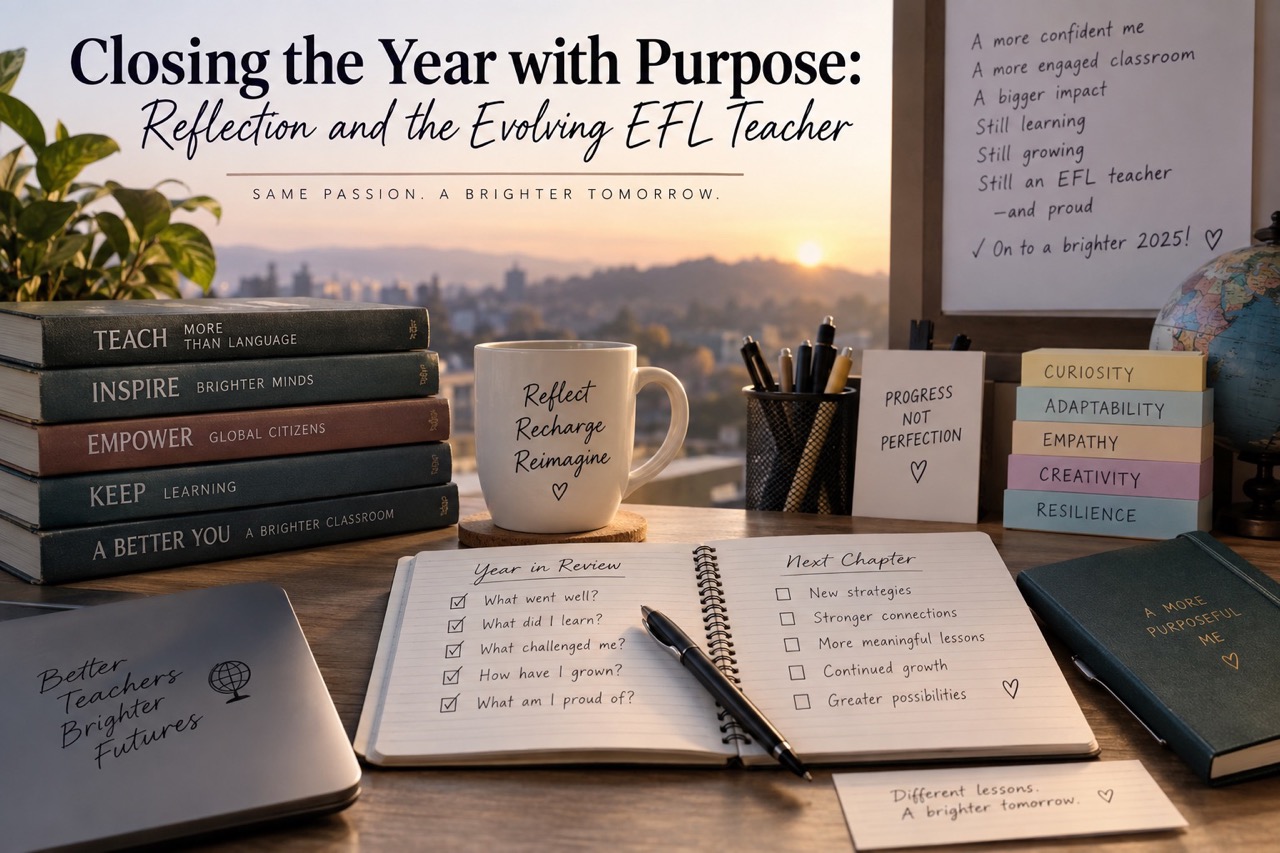
As the academic year comes to an end, we can find ourselves caught between exhaustion and urgency. Reports need to be completed, exams are finalised, and classrooms are packed away. In the meantime, trying to be practical the dominant question in our mind is ‘Have I completed everything?’ but perhaps an equally meaningful question could be ‘What have I learned from teaching my students?’.
End-of-year reflection is not simply a ritual of closure -it is a critical phase in professional growth. It offers educators the opportunity to transform experience into insight, and insight into intentional action for the future. Research in TESOL consistently shows that reflective practice helps teachers connect their classroom actions with their beliefs and professional identity, leading to deeper and more sustained development (Farrell & Macapinlac, 2021).
Why Reflection Matters
In the fast-paced and dynamic reality of EFL classrooms, it is easy to move from one lesson to the next without pausing. Yet, without reflection, even years of teaching can result in repeated routines rather than meaningful growth. As Thomas S. C. Farrell argues, reflection allows teachers to move beyond automatic teaching and become more aware, adaptive, and intentional practitioners (Farrell, 2023).
Reflection is not limited to looking back. It involves making sense of past experiences, understanding present practices, and shaping future action. This ongoing process transforms teaching from a series of isolated events into a coherent professional journey.
Looking Inward: The Teacher Behind the Practice
- What did I learn about myself as a teacher this year?
- How will I nurture myself this summer?
These deceptively simple, but deeply meaningful questions can guide us during this reflective process as they shift the focus from performance to identity by inviting us to examine not only what we did, but also who we were in the classroom.
Reflective practice research highlights that teacher development is not just about acquiring new techniques, but about understanding one’s own beliefs, emotions, and responses to classroom experiences (Farrell & Macapinlac, 2021). Perhaps you discovered that you are more creative than you allowed yourself to be or that you rely on structure more than you realised, and experimenting with flexibility brought unexpected results.
Equally important is the question that follows: How will I nurture myself?
Recent research in language education has emphasised that sustainable teaching depends on teacher well-being and resilience. Reflection plays a key role as it helps teachers recognise sources of stress and identify strategies for maintaining balance and motivation (Farrell, 2023). Nurturing yourself may involve professional learning, but it may also mean rest, disconnection, and creating space for renewal.
Looking Back: Lessons, Memories, and Insights
Beyond self-awareness, reflection also involves identifying what we carry forward.
- What key lessons, memories, and insights will I take into next year?
This question encourages us to move beyond individual lessons, lesson plans and methodologies and consider patterns across the year. Which moments stood out? Which challenges led to growth? Which “small wins” felt meaningful -not just in terms of outcomes, but in terms of connection and engagement?
This can help us make sense of our experiences and turn them into actionable knowledge for future reference. By revisiting classroom events, we are better able to identify what worked, what didn’t, and why – leading to more informed decisions in the future (Farrell & Macapinlac, 2021).
What is noteworthy is that this process is not about judging success or failure as some of the most valuable insights emerge from moments of difficulty. Reflecting on challenges can allow us to dive deep and uncover assumptions, reconsider approaches, and develop more flexible strategies to become better prepared for what comes next.
Sharing Practice: Building a Collective Toolkit
As educators, we must admit that we often work in isolation, even within busy institutions. However, one cannot doubt that when we come together to reflect (e.g. in webinars, workshops, or informal conversations) we create opportunities for collective growth. Revisiting favorite activities of the year is one way to do this. Which tasks engaged students effectively? Which strategies supported participation, motivation, or language development?
By comparing experiences, exchanging ideas, and reflecting as a group, reflection is combined with empathy, and self-awareness transforms into collective knowledge. As a result, individual insights become shared resources—a collective “toolkit of what works.”
From Closure to Continuity
As the year ends, reflection allows us to shift from a mindset of closure to one of continuity. Through conscious reflection, each year builds on the next and we begin to see teaching not as a series of disconnected academic years, but as an evolving professional journey.
So, before you close your planner for the last time, take a moment to pause and ask yourself:
- What did I learn about myself as a teacher this year?
- How will I nurture myself this summer?
- What will I carry forward into the next chapter of my teaching?
These questions not only mark the end of a year, but they also shape the beginning of the next. After all, let us not forget that in teaching, growth does not come from experience alone, but from the meaning we make of it.
References
Farrell, T.S.C. (2023) ‘Reflective practice for TESOL teachers: What, why, when and how’, JALT Publications. Available at: https://jalt-publications.org/articles/28082-expositions-reflective-practice-tesol-teachers-what-why-when-and-how (Accessed: 30 April 2026).
Farrell, T.S.C. and Macapinlac, M. (2021) ‘Professional development through reflective practice: A framework for TESOL teachers’, Canadian Journal of Applied Linguistics, 24(1), pp. 1–18. Available at: https://journals.lib.unb.ca/index.php/CJAL/article/view/28999 (Accessed: 30 April 2026).
Further Reading
- Donald Schön (1983)
The Reflective Practitioner: How Professionals Think in Action - Thomas S. C. Farrell (2015)
Promoting Teacher Reflection in Second Language Education - Thomas S. C. Farrell (2018)
Reflective Practice for Language Teachers - Simon Borg (2006)
Teacher Cognition and Language Education - Sarah Mercer and Tammy Gregersen (2020)
Teacher Wellbeing - Mann, S. and Walsh, S. (2017)
Reflective Practice in English Language Teaching: Research-Based Principles and Practices - Richards, J.C. and Lockhart, C. (1994)
Reflective Teaching in Second Language Classrooms
A classic guide offering practical strategies for reflective teaching.