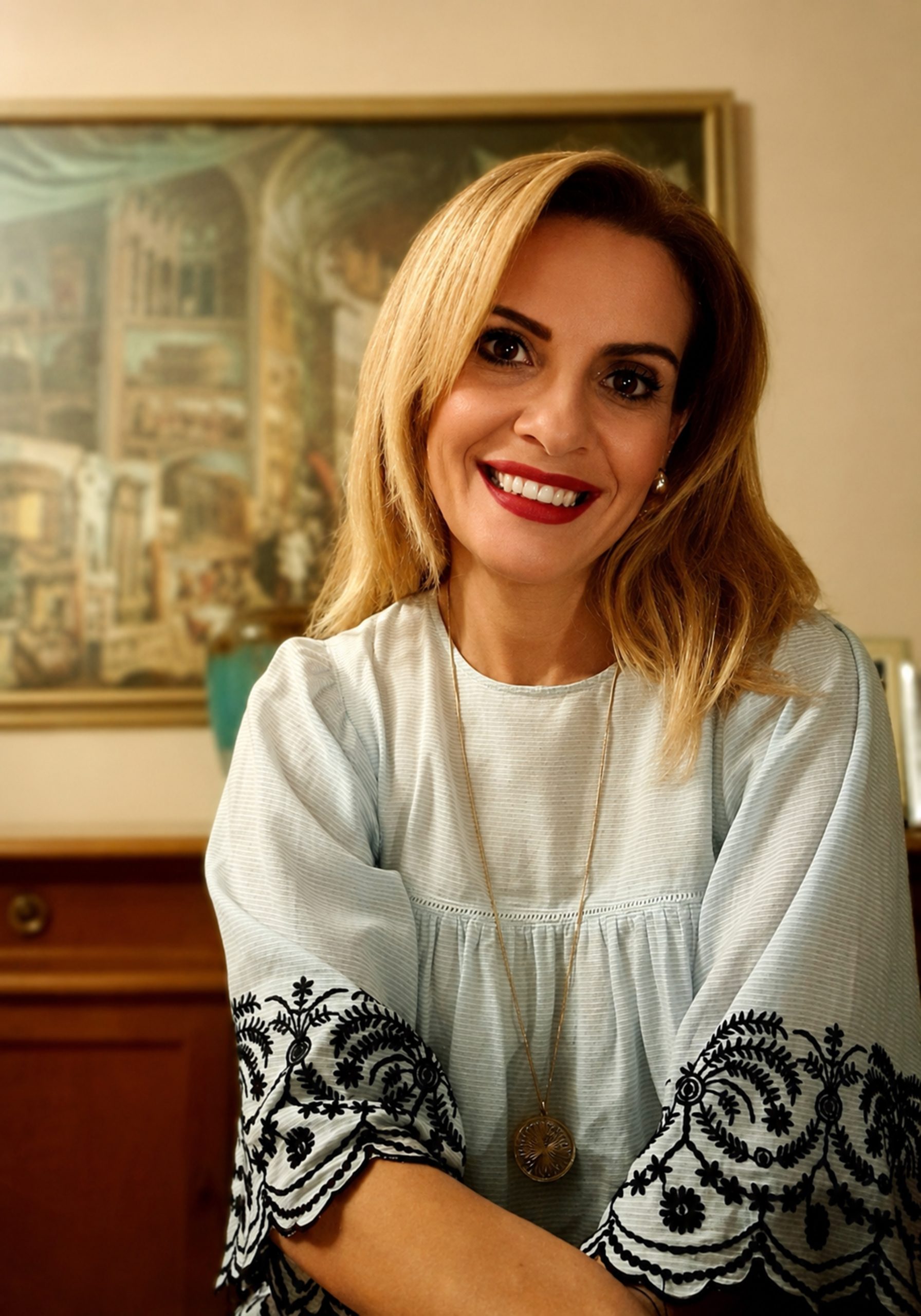
Vasiliki is an EFL and IB Diploma English A Language & Literature and English B teacher. She holds a BA in Medieval and Modern Greek Philology from the National and Kapodistrian University of Athens, an MA in Special and Inclusive Education from Nottingham Trent University (UK), and an MA in Applied Linguistics/TESOL (Hellenic American College, Athens).
In this interview, she reflects on the philosophy of the IB programme, the realities of teaching English within it, and the challenges and opportunities it presents for both students and educators in Greece.
- What drew you to the IB program, and what surprised you most once you started teaching within it?
What I have always valued about the IB program is its holistic approach to education, as reflected in IB learner profile. The program gives equal priority to academic achievement and the development of responsible, ethical, caring, and open-minded global citizens. Academic skills are cultivated through inquiry, critical thinking, research, and intellectual risk-taking within a clearly student-centred framework where teachers act as facilitators offering students ample opportunities for autonomy in the learning process.
While many contemporary systems claim to promote similar values, the key difference with the IB is that these principles are not just negotiable theoretical statements but embedded in the official framework, meaning that all stakeholders must conform to them. To give you an example, we talk about the importance of developing young people’s community engagement. In the IB program, giving back to society is mandatory through Creativity, Activity, and Service (CAS) -it is a core requirement for earning the Diploma.
- What is the biggest gap you observe between what Greek students expect from English lessons and what IB demands from them?
One of the most significant challenges is that nowadays, many students develop their English primarily through social media and gaming. This often leads them to overestimate their language skills with an occasional mismatch between perceived and actual proficiency.
Expectations also vary depending on the course. English B, which focuses on second language acquisition, resembles a C1-C2 ESL course. In contrast, English A treats students as native speakers. Obviously, the demands are much higher as students are expected to analyze literary and non-literary texts, applying critical thinking, critical discourse analysis, and a variety of literary theories. As a result, students with strong language qualifications or even a bilingual background may struggle to meet the demands of the English subjects, as linguistic competence does not necessarily translate into analytical ability.
- The IB learner profile sounds ideal on paper. How do you translate attributes like “critical thinking” into concrete classroom tasks?
Indeed, critical thinking lies at the core of the teaching and learning process in the IBDP program. Honestly, this can be very challenging, especially for students accustomed to more teacher-centred approaches. Therefore, critical thinking should be primarily realized through a student-centred approach, leaving behind “spoon-feeding” practices. This involves scaffolding learning, fostering metacognitive awareness, and encouraging research skills. In practice, when students come with questions/inquiries, teachers should show them how to find the answers rather than provide them. Students should be engaged in independent research tasks, followed by debates, reports, presentations, or other reflective tasks.
In my own teaching practice, I love playing the devil’s advocate, for example, when discussing characters’ motives in a novel or a short story to challenge assumptions and deepen analysis. Generally, we need to keep in mind that not providing straightforward answers is not a lack of support. On the contrary, it is a deliberate teaching strategy closely aligned with the Socratic method that empowers students to think critically and independently.
- Do stronger “exam students” always perform well in IB, or do you see unexpected struggles?
Not necessarily, and I would dare say this is the tricky part. As mentioned before, students holding C2-level qualifications may feel confident in their linguistic skills. However, IB courses require them to go beyond linguistic competence and engage critically with authentic material, such as identifying a writer’s purpose and motives through linguistic features and authorial choices.
Therefore, it must be made clear that a solid linguistic background is certainly beneficial as long as it is complemented with metacognitive and critical thinking skills, and constant exposure to authentic material.
- What does it take -time, cost, commitment- to become an IB English Language teacher in Greece?
Teachers must recognise that their role extends beyond delivering content; they are preparing students for academic pathways that can shape their future opportunities. In practice, it is not about preparing students for a certificate but about university entry requirements. Specifically for the English language course, students aim for a very high grade (with 7 being the highest grade they can achieve in the IB exams). Therefore, being aware of our responsibility is very important.
In practical terms, teachers’ training is essential. The International Baccalaureate Organization offers online professional development workshops. These workshops, typically lasting four weeks and costing approximately 500 euros per course, are offered in different categories, addressing different levels of experience, and cover all IB subjects. Alternatively, many educators benefit from attending seminars/workshops led by experienced IB instructors who often provide more practical, classroom-based insights. Ultimately, while formal training is essential, continuous professional development and classroom experience are equally vital.
- To what extent is it realistically achievable for an average private language school to offer courses specialized in the IBDP?
From a pedagogical perspective, I think it is achievable – provided all stakeholders (school owners, directors of studies, teachers, parents, students) align with the same educational mindset and philosophy and are committed to collaborating to make a difference. School owners, directors of studies, and teachers should invest in their professional development and be willing to learn, re-learn, and even un-learn. At the same time, parents and students should realize that an English course within the IB framework comes with different requirements and expectations compared to a more “traditional” language instruction framework.
Having said this, if the development of critical thinking, along with communicative, social, and research skills, has already been part of our school philosophy, then the transition to an IB-oriented approach can be relatively smooth. Fortunately, this is the case for many foreign language schools.
From a business perspective, there may be reservations, e.g., if it is worth the time, money, and effort to offer specialized IBDP courses, given that, for the time being, the number of students interested in IBDP courses might be limited. However, with the ongoing changes in the national education landscape, interest in the IB program is likely to grow. Therefore, language schools should decide whether they want to position themselves within this evolving future-oriented education.
- If a foreign language school adopts IB without fully understanding its philosophy, what may go wrong?
The IB mission is summarized in the following: 1. To develop inquiring, knowledgeable and caring young people who help to create a better and more peaceful world through intercultural understanding and respect. 2. To encourage students across the world to become active, compassionate and lifelong learners who understand that other people, with their differences, can also be right.
If this philosophy is not fully understood or embraced, there is a risk that the IB becomes reduced to just another examination system. In such cases, its most valuable dimension -the development of thoughtful, reflective, and globally minded individuals- is lost.