In my own teaching practice, the coursebook has for many years been the main point of reference for lesson planning. Despite its clear structure and well-defined language objectives, I gradually realized that many of its activities did not lead students to meaningful use of the language. On the contrary, they often remained limited to the mechanical reproduction of forms, without a genuine communicative purpose. This observation led me to explore ways in which I could retain the coursebook as a useful tool, while at the same time fostering authentic communication in the classroom.
I vividly recall a fill-in-the-gap activity on the Present Simple tense. Students were initially working individually on sentences such as
“She ___ (go) to school at 8 o’clock” or
“He ___ (play) football on Sundays.”
Although most students provided correct answers, the process remained largely mechanical and engagement was limited. In an effort to help students use the language more meaningfully, I asked them to transform the sentences into questions and ask each other. This led to questions such as “What time do you go to school?”, “Do you play football on Sundays?” and “Where do you spend your afternoons?”. In a follow-up stage, students reported their peers’ answers back to the class (e.g. “Maria goes to school at 8 and plays tennis twice a week”).
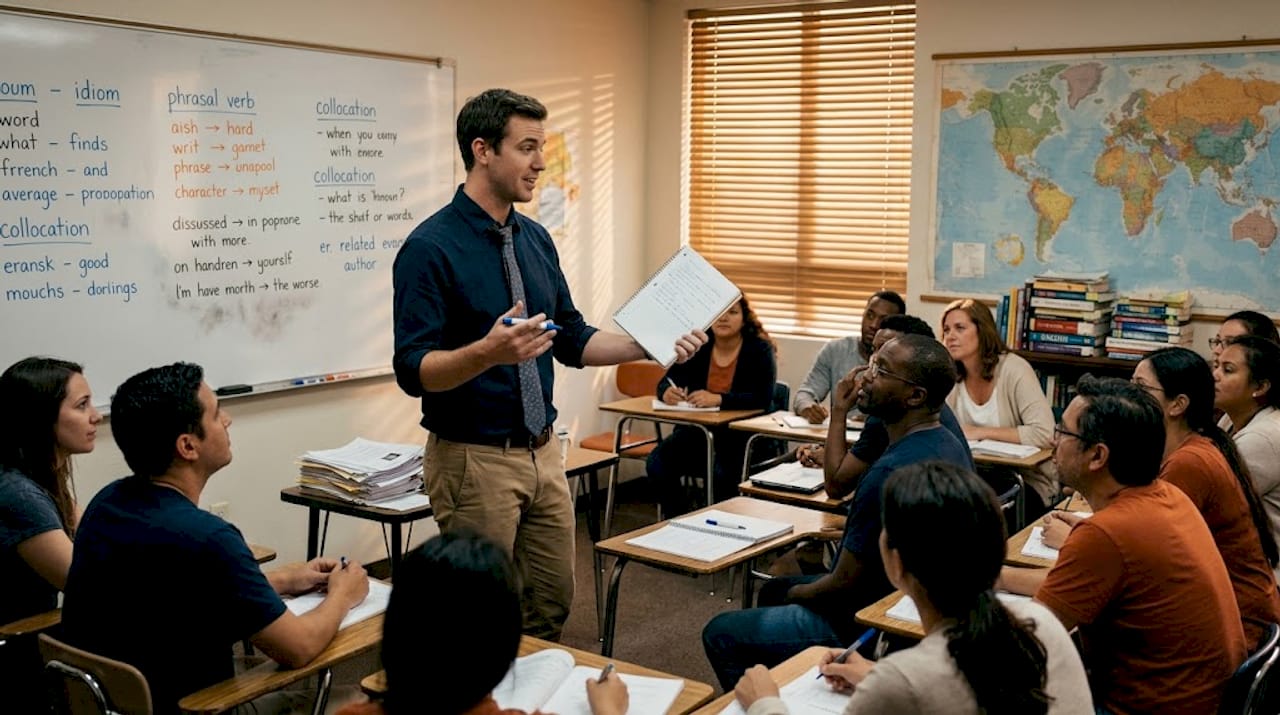
The change in classroom dynamics was immediate. Students began interacting with multiple peers and using the language more spontaneously. The focus shifted from grammatical accuracy to successful communication, while even lower-level learners participated actively by repeating or reformulating questions in order to be understood.
Building on this experience, it becomes evident that relatively small adjustments can transform textbook activities into opportunities for authentic communication.
A similar shift can be applied to vocabulary work, for example in units focusing on jobs. Instead of relying on matching exercises (e.g. doctor – works in a hospital, chef – cooks food), teachers can introduce describe-and-guess activities. Each student can be given a card with a job and be asked to describe it without naming it, using simple phrases such as “This person works at night”, “They help sick people” or “They wear a
uniform.” The rest of the class tries to guess the job by asking questions like “Do they work indoors?” or “Do they work with children?” This activity can be extended by asking students to include a less obvious or even misleading clue, thereby fostering creativity and deeper engagement.
Similarly, textbook dialogues can be used as a springboard for open-ended role-play activities. For example, in a unit on eating out, students can take on roles (customer, waiter) and be asked to manage specific scenarios such as a wrong order, an unavailable dish, or special dietary requirements (“I’m allergic to nuts”, “I ordered something else”). The teacher may provide role cards with brief prompts, while leaving the development of the interaction open. In this way, students are encouraged to use language spontaneously and adapt it to unpredictable situations.
In addition, “Find someone who…” activities can create a highly dynamic communicative environment. For instance, to practise the Present Perfect tense, students can be given a worksheet with prompts such as “Find someone who has visited another country”, “Find someone who has tried sushi” or “Find someone who has met a famous person.” Students move around the classroom asking questions (“Have you ever visited another country?”) and noting down names. At the end, they report their findings (e.g. “Three students have visited another country”), adding a stage of reflection and consolidation.
Such activities require minimal preparation but can significantly alter the nature of classroom interaction, transforming language practice from an individual, mechanical process into a collaborative and communicative experience. Within this perspective, language is not treated merely as a system of forms to be mastered, but as a dynamic tool for meaning-making.
In many ways, this way of working reflects key ideas from Communicative Language Teaching, especially the concept of communicative competence introduced by Dell Hymes. It is also closely connected to Task-Based Language Teaching, as described by Jane Willis and Rod Ellis, where students use language to complete meaningful tasks. At the same time, it aligns with the view of learning as a social process, as emphasized by Lev Vygotsky, where interaction plays an important role. From this perspective, language is not just something to practise correctly, but something to use to communicate meaning. Even small
adaptations to coursebook activities can contribute to the creation of richer communicative environments, where learners engage with language in purposeful and socially meaningful ways.
Citations:
Ellis, R. (2003). Task-based language learning and teaching. Oxford: Oxford University Press.
Hymes, D. (1972). On communicative competence. In J. B. Pride & J. Holmes (Eds.), Sociolinguistics (pp. 269–293). Harmondsworth: Penguin.
Vygotsky, L. S. (1978). Mind in society: The development of higher psychological processes. Cambridge, MA: Harvard University Press.
Willis, J. (1996). A framework for task-based learning. Harlow: Longman.