A new Cambridge University Press publication is examining one of the areas where generative artificial intelligence could have its greatest impact on English language teaching: writing feedback and assessment.
Generative AI for Second Language Writing Feedback, Assessment, and Instruction, published on 3 September 2026, brings together current research into the use of generative AI in second-language writing.
Its publication reflects how quickly automated writing assessment has developed.
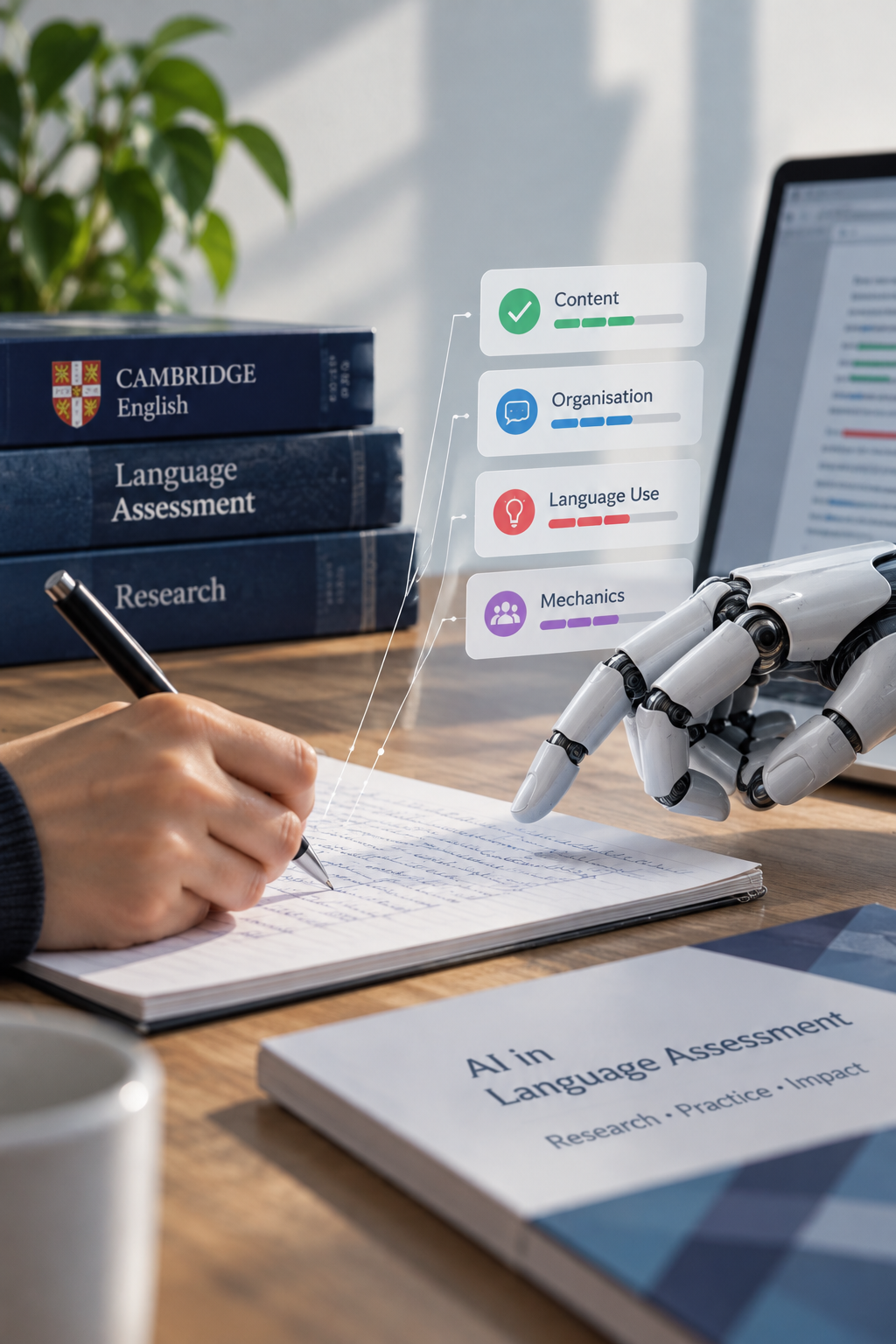
Language teachers have used digital grammar and spelling tools for years. Generative AI goes considerably further. Current systems can analyse organisation, vocabulary, grammatical accuracy, task completion and aspects of style while producing detailed feedback almost immediately.
For teachers dealing with large numbers of written assignments, the attraction is obvious.
But automated feedback also raises questions that ELT has yet to resolve fully.
How reliable is AI when assessing writing against a particular examination rubric? How much feedback should learners receive? Should AI identify errors or explain them? And at what point does assistance begin to interfere with the learner’s own development as a writer?
There is also an important distinction between feedback and assessment.
AI may prove particularly useful as a formative tool, helping students identify weaknesses before submitting work. High-stakes assessment requires a much higher standard of reliability, transparency and consistency.
The question for teachers is therefore becoming more specific. It is no longer simply whether AI belongs in writing instruction.
It is where it belongs, what decisions it should be allowed to make and where professional teacher judgement remains essential.