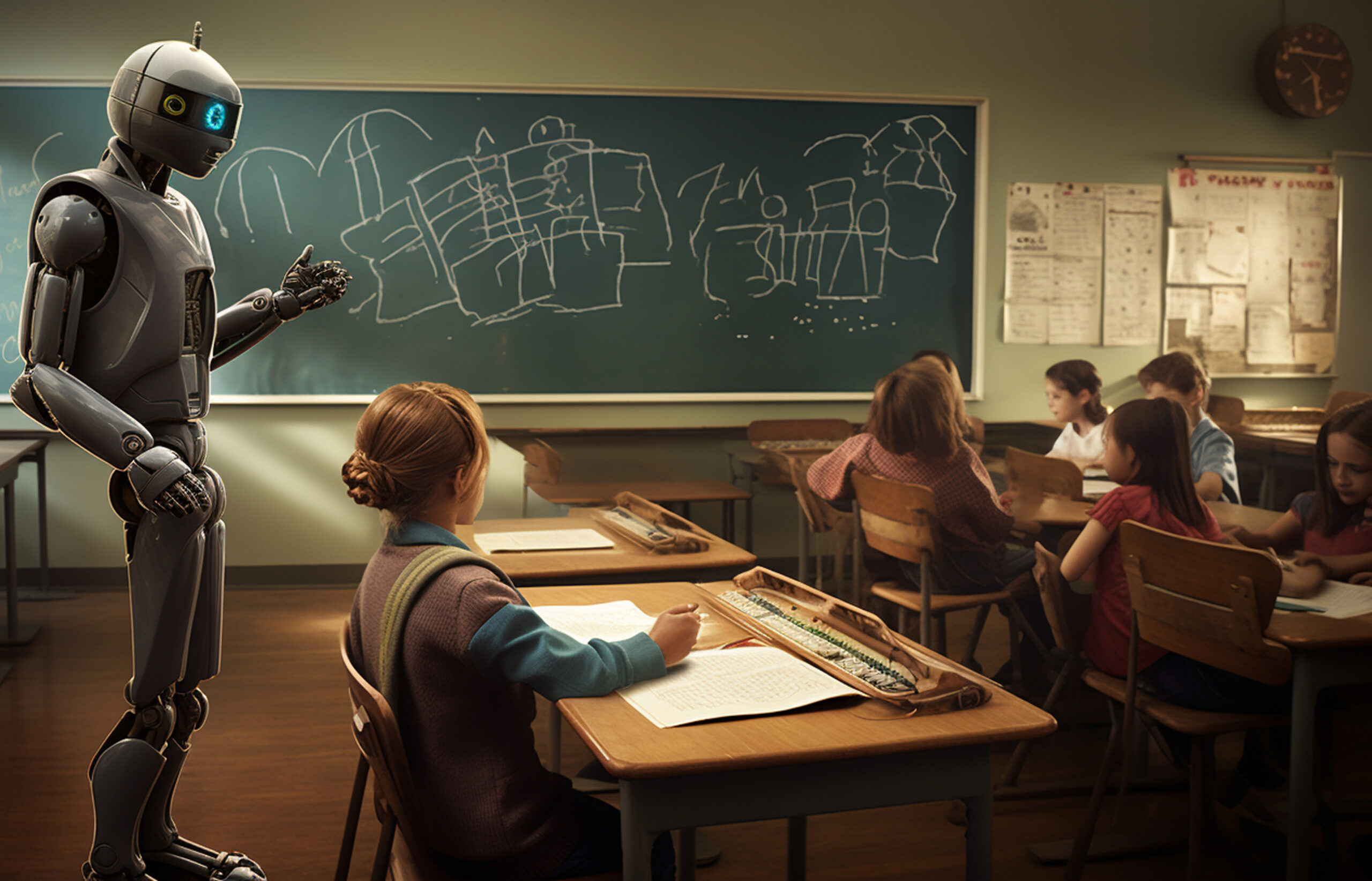
The arrival of artificial intelligence in education has triggered a familiar cycle: excitement, anxiety, and an avalanche of predictions about the end of teaching as we know it so far. Yet a more grounded reality is emerging beneath the noise. The teacher is not removed by the AI – it is reshaping the role by stripping away tasks that were never distinctly human and exposing what truly is.
For decades, much of teaching has revolved around delivering content, explaining concepts, and assessing student performance. AI now performs many of these functions very efficiently. It can adapt materials to different levels, generate explanations in seconds, provide instant feedback, and even simulate dialogue. In practical terms, this means that the teacher is not anymore, the primary gatekeeper of information but students can access explanations anytime, anywhere, often tailored to their exact needs.
This change is not theoretical—it is already visible in classrooms. Teachers report that they spend less time creating basic materials and more time curating, adapting, and questioning them. Homework tasks that have once demonstrated understanding can now be completed with minimal effort by using AI tools. Assessment, in its traditional form, is also being affected. The change is structural and not just technological.
But what AI removes is only part of the story. More important is what it reveals. When information is abundant and easily generated, the value of education changes from producing answers to making sense of them. This is where the teacher’s role becomes indispensable. AI can generate a convincing explanation, but it cannot judge its appropriateness in a specific learning context. It cannot fully understand the nuances of a student’s motivation, their confusion, or their intellectual habits. It cannot notice curiosity, hesitation, or disengagement in the way a human teacher can.
In this sense, the teacher’s role involves less explanation but more interpretation, guidance, and design. Firstly, there isjudgment. Students increasingly need help evaluating the quality of generated information. AI outputs are often fluent but not always accurate or meaningful. Teachers help students ask better questions: Is this explanation reliable? Does it make sense? What is missing? This kind of critical engagement cannot be outsourced.
Secondly, there is meaning making. Learning does not mean simply acquiring information. It is connecting ideas to context, experience, and purpose. AI can provide answers, but it does not care whether those answers matter to the learner. Teachers create conditions where knowledge becomes meaningful—through discussion, challenge, and relevance.
Thirdly, there is attention and motivation. AI responds may be instant, but it does not sustain engagement over time. It cannot build relationships. A teacher, however, can recognize when a student is drifting, frustrated, or disengaged—and they intervene in ways that are human, subtle and often decisive. At the same time, this transformation forces difficult decisions about what to preserve and what to abandon.
Some elements of traditional education are worth protecting precisely because AI makes them more fragile. Struggle, for example, is essential to the learning process. students may lose the ability to persist through complexity if every difficulty is smoothed away by instant answers. Original thinking and voice also become more valuable in a world of generated text. Similarly, dialogue remains irreplaceable.
Protecting forms of assessment that value process over product is equally important. When polished outputs can be generated effortlessly, the path to those outputs becomes the true evidence of learning. At the same time, some practices need to be reconsidered. Assignments that can be completed entirely by AI without reflection offer little educational value. Rote memorization, long treated as a proxy for understanding, is less defensible when information is instantly accessible. The idea of the teacher as the sole authority in the classroom is also increasingly untenable.
These elements are not easy to let go. They are deeply integrated into educational systems and expectations. But holding onto them risks creating a disconnect between how students learn and how learning is measured. So, the real challenge is not whether to use AI, but how to integrate it in ways that support thinking process rather than replace it.This requires intentional design. Assignments must evolve to require interpretation, comparison, and justification—things AI cannot fully do automatically. Classrooms should become places where answers are questioned, not just produced.
In this landscape, the teacher’s role becomes more complex, not less. It requires a deeper understanding of learning, a sharper sense of purpose, and a willingness to adapt to a different era. Far from making teachers obsolete, AI raises the standard for what good teaching looks like. AI does not ask whether teachers are still needed. It asks for something more demanding: whether we are prepared to redefine teaching around what humans do best.