The Greek Ministry of Education has issued its official guidelines for teaching English in kindergarten for the 2026–27 school year, confirming the place of English within early childhood education in the state system.
Published on 3 September following a recommendation from the Institute of Educational Policy (IEP), the guidance covers the implementation of English-language activities within the kindergarten programme.
English was introduced into Greek kindergartens nationally following an earlier pilot programme, bringing foreign-language learning into children’s formal education considerably earlier than in previous generations.
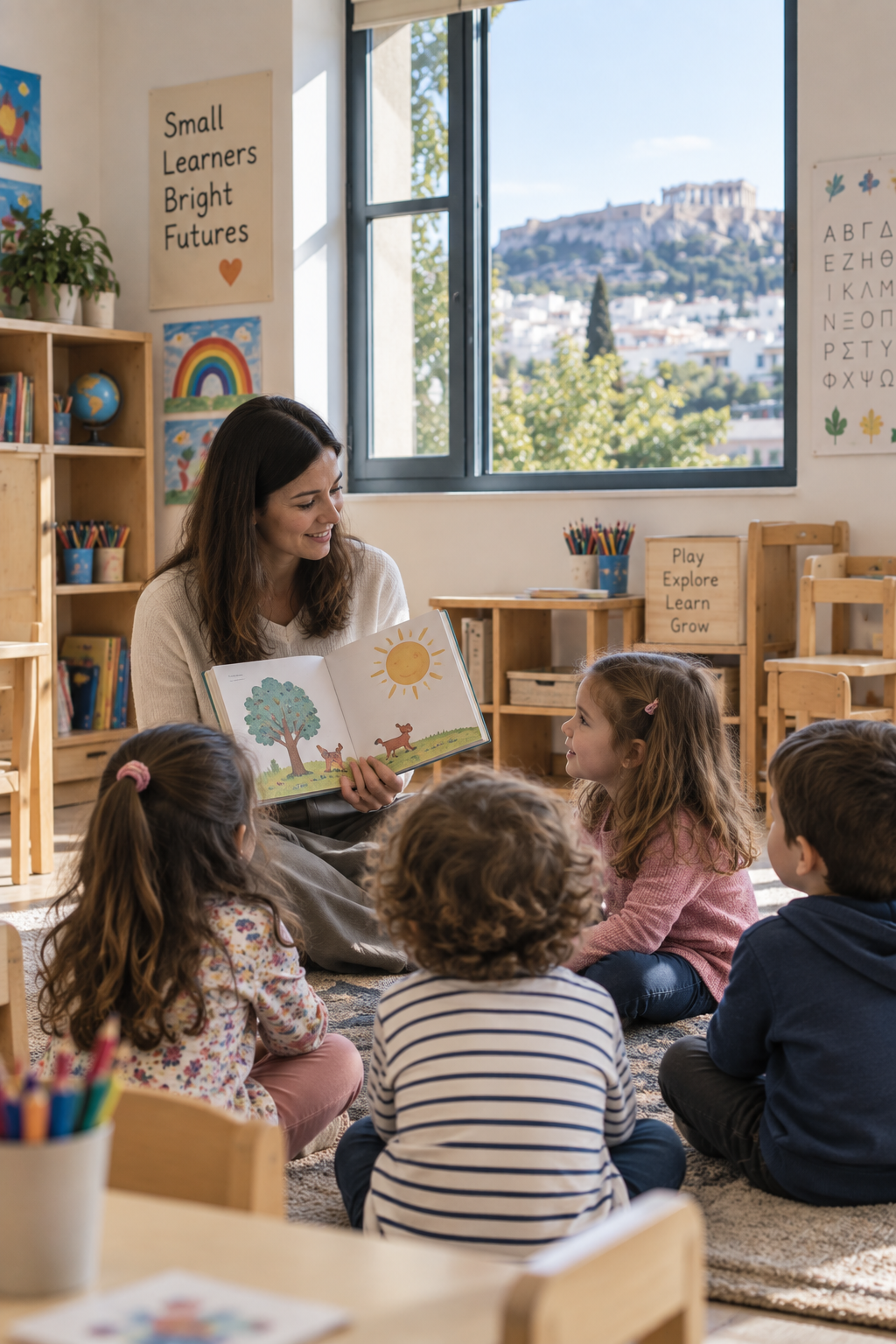
The programme is not intended to turn kindergarten into a conventional language classroom. Its approach centres on age-appropriate activities, communication and play, with cooperation between the English teacher and kindergarten teacher.
Children entering private language education in the coming years will increasingly arrive with some previous exposure to English through the state system. Their experiences and abilities will vary, but the traditional assumption that Junior A represents a child’s first encounter with English is becoming less reliable.
This could eventually require private language schools to reconsider the relationship between pre-Junior programmes, Junior A and the English children encounter in kindergarten and primary school.
Early exposure does not automatically produce effective language acquisition. Much depends on the quality of activities, teacher preparation, continuity between educational stages and children’s opportunities to use English meaningfully.
For Greece’s ELT sector, however, something fundamental has changed: the age at which English education begins can no longer be defined solely by the private language school.
Source: