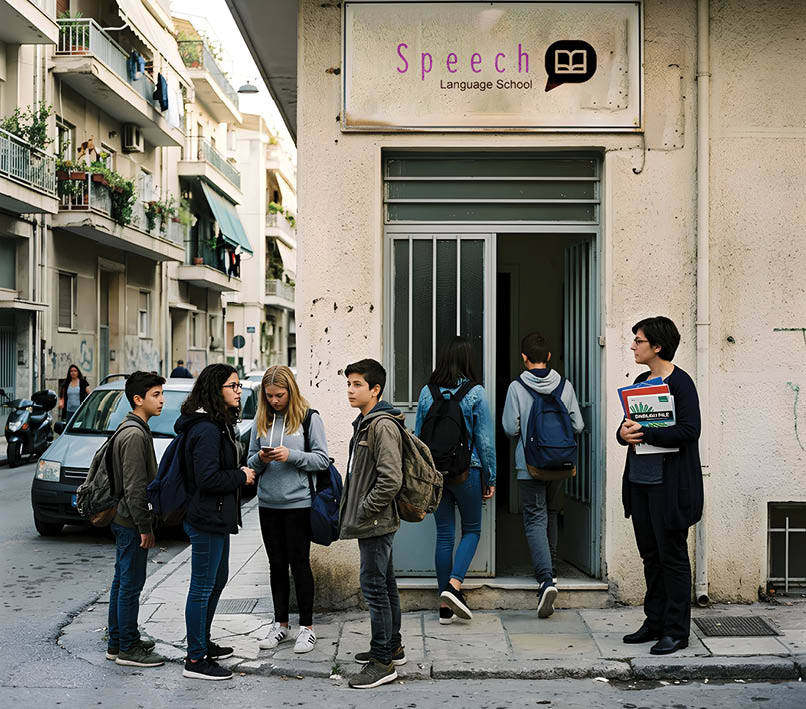
For years, the ELT publishing industry in Greece operated on a comforting assumption: competition might intensify, the market might wobble, but demand would always replenish itself. A new generation of learners would enter the system, language schools would keep enrolling beginners, and publishers would continue fighting for a share of a market large enough to sustain several players.
That assumption is starting to collapse.
Demographics are far less forgiving than weak sales cycles or temporary disruptions. Greece’s birth rate has been declining for years, and the consequences are now fully visible. This is not a hiccup like the COVID period six years ago. Around 65,000 students are expected to enter the educational system in 2030, followed by a further drop of roughly 10% the year after. Call them projections if you like, but the numbers are already locked in. No campaign can reverse them. No positioning strategy can create students who were never born.
The size of the future ELT market is no longer a question. It is, to a large extent, already determined. Even if participation in private language education remains strong, and Greece has historically shown a deep commitment to foreign language learning, the total pool of students entering the system will shrink. That changes the rules.
In a growing market, multiple publishers can thrive. Expansion absorbs inefficiencies. One company’s success does not automatically come at another’s expense. In a shrinking market, that logic disappears. Every gain has a counterpart. Every adoption is taken from someone else. When a school switches coursebooks, it is not creating demand. It is reallocating it.
The industry still looks active. New titles appear. Marketing continues. Conferences remain busy. From the outside, little seems to have changed. But the base is weaker. Schools in many areas are already reporting smaller intakes. Beginner classes are harder to form. The competition for each student is intensifying, and that pressure will not stay at classroom level. It moves upstream.
There is still a tendency to treat this as temporary. It is not. This is not a bad year or a slow season. Twenty years ago, a 30% market share could sustain a strong business. In the coming years, the total size of that same segment may resemble only a fraction of what it once was. That is the scale of the shift.
This is where things become uncomfortable. In a larger market, inefficiencies can hide in plain sight. Spending habits built on tradition rather than performance go largely unquestioned. Regional exhibitions with unclear return. Presence at every local event. Sponsorships that signal activity but deliver little. When the market grows, these choices are tolerated. When it contracts, they become liabilities.
Cost discipline is no longer optional. It is inevitable. Not because visibility loses value, but because visibility without return becomes expensive noise. Margins will tighten. Cash flow will matter more than exposure. The publishers still operating a decade from now will not necessarily be the most visible ones. They will be the ones that understand their numbers, control their costs, and invest with precision.
The instinct to be everywhere is losing relevance. Being trusted in the right places matters more. Relationships with schools will carry more weight than brand presence alone. Teachers will expect support, not just materials. Directors of studies will look for partners, not suppliers. The shift is subtle, but it is decisive. In a smaller market, relevance wins. Trust compounds.
At the same time, the geographic horizon is changing. For several publishers, Greece is no longer enough. Expansion is not a luxury, it is becoming a necessity. Europe, the Middle East, parts of Asia, Latin America, these are no longer peripheral markets. They are where scale still exists. Where growth is still possible. Greece, by contrast, risks becoming a base rather than a driver.
Good books will still matter. That has not changed. But they are no longer sufficient on their own. Survival will depend on financial resilience, commercial clarity, and the ability to distinguish between activity and effectiveness. The publishers that endure will be those who cut decisively, invest deliberately, and build relationships that hold under pressure.
Markets do not shift because numbers change. They shift because people either adapt or refuse to. That is why this conversation matters now, before reality forces it.
The Greek ELT market will not disappear. But it will become smaller, tougher, and far less forgiving. Not everyone will survive it.