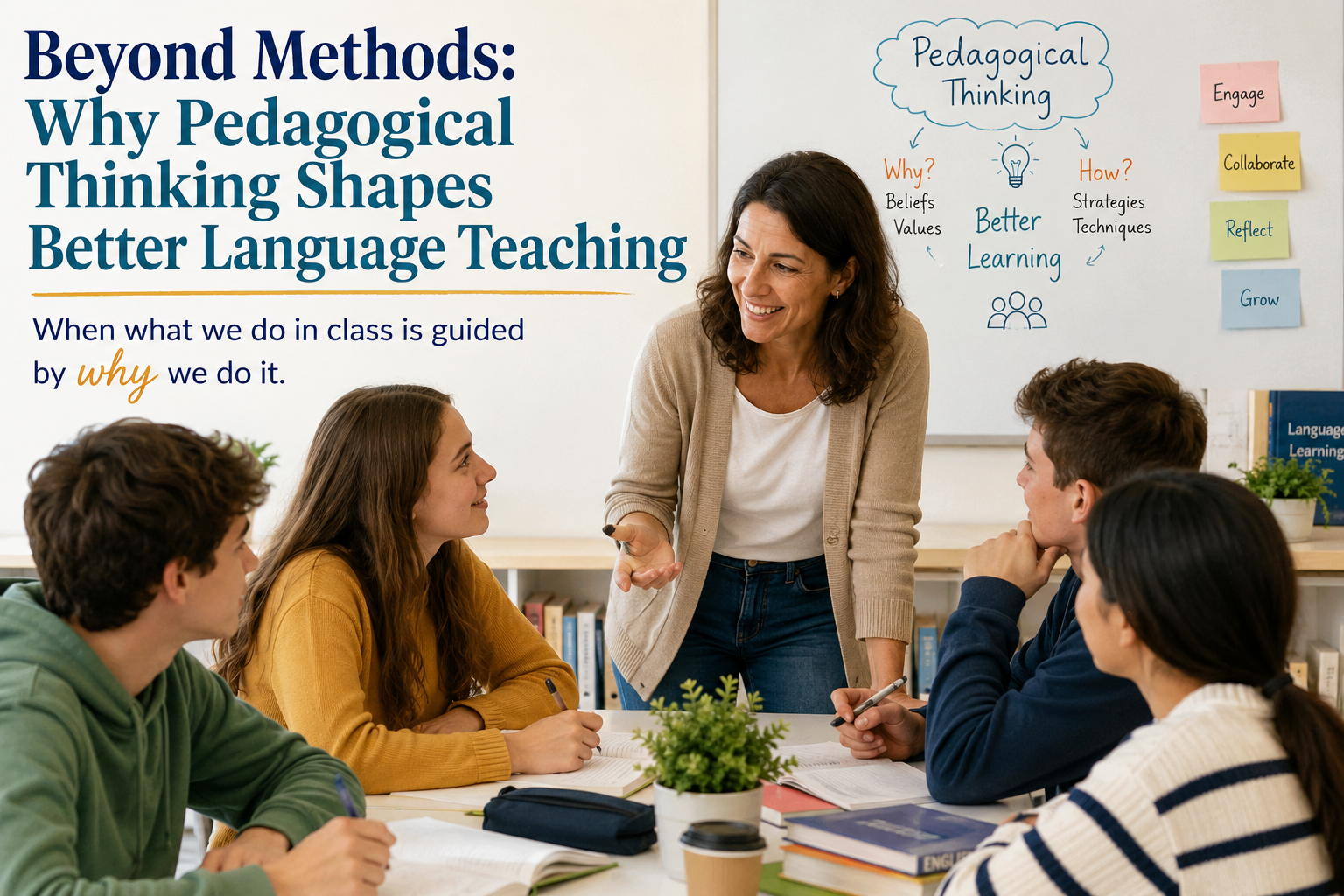
Every lesson begins long before students enter the classroom. Decisions about how to introduce new language, organise pair work, respond to errors or assess understanding may seem routine, yet each reflects a teacher’s underlying beliefs about how learning takes place. Whether consciously or not, teachers bring a personal educational philosophy into every lesson they teach.
This relationship between classroom practice and pedagogical thinking is what transforms teaching from a sequence of activities into a purposeful professional practice. Methods alone do not create meaningful learning. Their effectiveness depends on the thinking that informs when, why and how they are used.
Looking Beyond Classroom Techniques
Pedagogical thinking is the framework that guides instructional decisions. It combines educational theory, professional experience, personal values and ongoing reflection into a coherent approach to teaching.
Teachers make hundreds of decisions every day. They choose whether to explain or elicit, when to intervene in group work, how much support to provide, and how to respond when learners struggle. These choices are rarely accidental. They reflect assumptions about motivation, language acquisition, learner autonomy, assessment and classroom relationships.
Those assumptions continue to evolve throughout a teacher’s career. Initial teacher education provides a starting point, but experience, professional development, research and reflection gradually reshape classroom practice. Effective educators remain open to questioning their own approaches as their understanding of learning develops.
When Practice Reflects Purpose
The connection between pedagogy and practice becomes visible in every aspect of classroom life. Lesson planning, questioning techniques, assessment, classroom management, differentiation and the integration of technology all communicate what a teacher believes about learning.
A classroom where learners are encouraged to ask questions, negotiate meaning and work collaboratively reflects a different educational philosophy from one centred primarily on repetition and teacher-led instruction. Neither approach exists in isolation. Most teachers draw from multiple pedagogical traditions, adapting their methods to suit their learners, objectives and teaching context.
What distinguishes experienced practitioners is not the number of strategies they possess, but their ability to explain why a particular approach is appropriate for a particular group of learners.
From Theory to Everyday Teaching
The link between educational theory and classroom practice becomes clearer when viewed through familiar teaching situations.
An inquiry-based lesson, for example, encourages learners to investigate questions, test ideas and construct understanding for themselves. This approach is rooted in constructivist theories, where learning develops through active engagement rather than passive reception.
Differentiated instruction reflects another pedagogical commitment. By adapting materials, activities or assessment to accommodate different learning profiles, teachers recognise that students do not progress at the same pace or in the same way. The emphasis shifts from treating every learner identically to providing equitable opportunities for success.
Collaborative learning draws on social theories of learning, recognising that interaction plays an important role in developing understanding. Pair work, peer feedback and cooperative tasks allow learners to build knowledge together through discussion, negotiation and shared problem-solving.
In each case, the classroom activity is only one part of the picture. The pedagogical thinking behind it gives the activity its educational purpose.
Reflection as Professional Practice
Teaching improves when educators regularly examine the relationship between what they do and the outcomes they observe.
Reflective practice encourages teachers to ask challenging questions after a lesson. Which activities genuinely supported learning? Which learners remained disengaged? What assumptions influenced instructional choices? Were assessment methods aligned with learning objectives?
These questions help transform everyday classroom experiences into opportunities for professional growth. Reflection also enables teachers to adapt their practice rather than relying on familiar routines simply because they have always worked.
Professional reflection can take many forms, from maintaining a teaching journal and discussing lessons with colleagues to participating in mentoring, lesson observations or continuing professional development.
Navigating the Gap Between Theory and Reality
Connecting pedagogy with classroom practice is not always straightforward. Teachers work within curriculum requirements, assessment pressures, time constraints and institutional expectations that may limit flexibility. Established routines can also make it difficult to experiment with new approaches, even when research suggests alternative methods may better serve learners.
For language teachers, this balance is particularly important. Every class presents different linguistic backgrounds, proficiency levels, motivations and learning preferences. Sound pedagogical thinking allows teachers to adapt without losing sight of their educational goals.
Rather than viewing theory as something separate from daily teaching, successful educators use it as a practical tool for making informed decisions in complex classroom situations.
Teaching with Intention
Effective teaching is not defined by the number of techniques a teacher employs, nor by strict adherence to a single methodology. It is characterised by purposeful decision-making, thoughtful adaptation and an ongoing willingness to reflect on practice.
When classroom actions are grounded in clear pedagogical thinking, teachers become better equipped to respond to learners’ needs, justify their instructional choices and continue developing professionally.
For language educators, this connection between practice and pedagogy is more than an academic concept. It is the foundation of responsive, inclusive and meaningful teaching, enabling every classroom decision to contribute to deeper learning and lasting educational impact.
• Bring electricity, internet, and computers to village schools.
• Build AI tools that speak local languages and dialects.
• Teach educators how to blend AI into their teaching, not replace them.
• Let community schools show the way with models like TCF’s.
• Create clear rules to protect student data and ensure fair access.
The real test will come when a child in rural Sindh types a short story in their language, instantly checks it in Urdu with AI, and then hears it spoken back. If that brings a smile, Pakistan will be on track to lead in language‑friendly education. Every child deserves that spark and this is how we can give it to them.